✨Interior images are AI-generated. Items shown are similar to those in the video.
Lujo Moderno
Bedroom with a veined mural and polished floor: controlling reflections
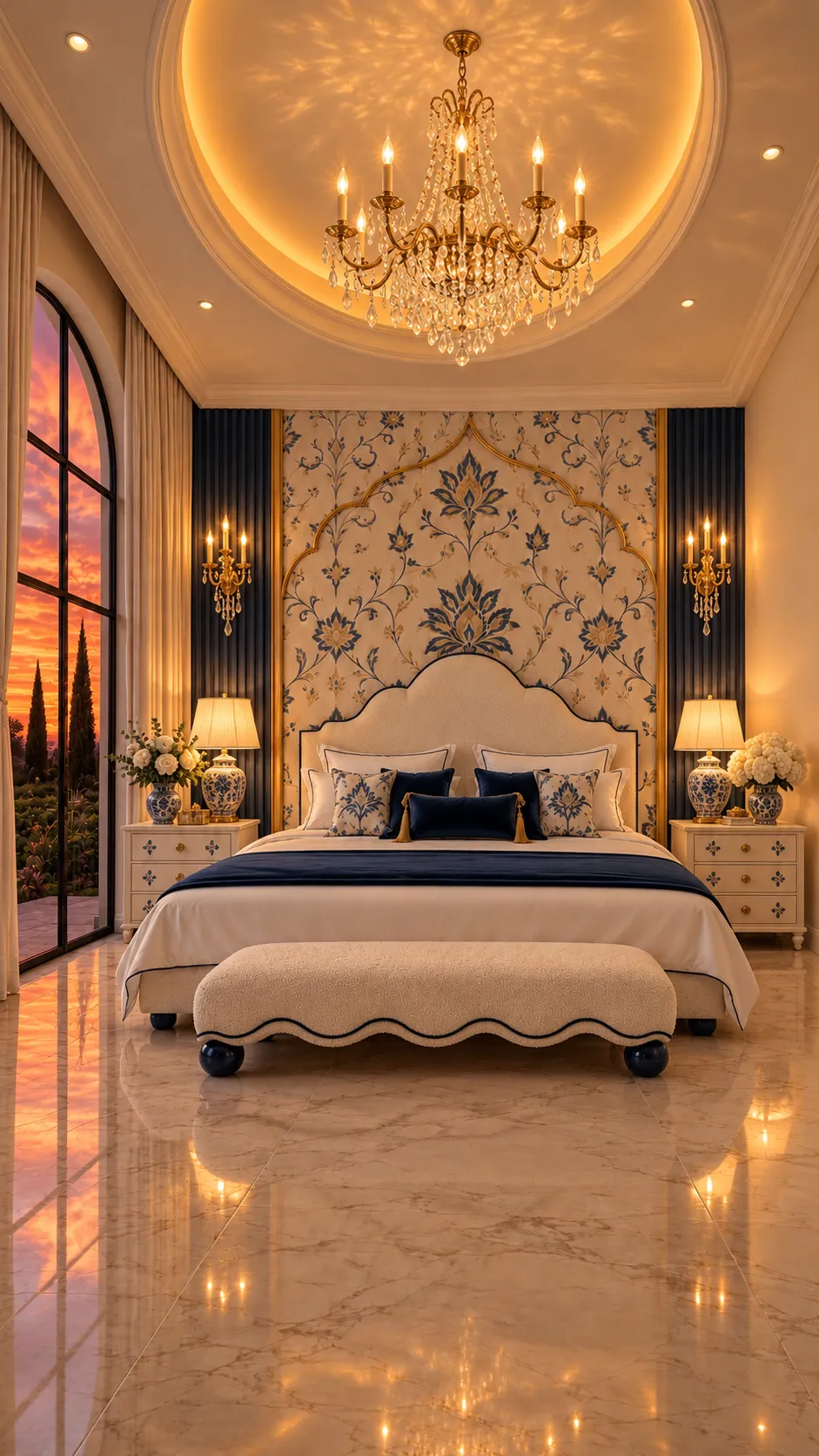
The headboard wall carries a veined mural in navy and gold, and the floor is polished marble. Both surfaces reflect, and when both shine at once the problem is practical rather than aesthetic: at night every light point appears twice, and the room goes from elegant to restless. The answer is not giving up the shine but deciding from the start where the light comes from and how much of the floor gets covered.
Suelo pulidoMural de vetaAzul marinoListones oscurosReflejosLuz regulableEfecto mármolAlfombra bajo la camaDetalles doradosDormitorio elegante
Design keys
A marble-veined mural in navy with gold veins, in a satin rather than gloss finish.
A polished marble floor with veining in the same tone family but a different pattern from the mural's.
Vertical dark walnut slats at the sides of the plane, the wall's only matt surface.
A short-pile rug under the bed covering the central zone, leaving the polish visible only at the perimeter.
All lighting dimmable, with no bare light point in view of the mirror or the floor.
Textiles in blue and raw, with gold limited to the ironmongery and the nightstand legs.
Furniture and decor in this design
5
Items shown are similar to those in the video, not necessarily identical.
Marble-veined effect wallpaper
A wide-veined mural in a satin finish, which is what suits an already polished floor. Ask for a sample before ordering the metres: the same design changes a great deal between matt and pearl finishes, and on screen they all look alike. If the plane has sockets, send the maker your dimensions so the veining does not land right over a fitting.
A dark-toned slat panel for the side planes, the only matt surface on a wall with a satin mural. Measure total thickness before buying: glued to the wall the panel takes about two centimetres, but on battens it goes to four or five, and that decides whether the walkway beside the bed stays comfortable. In a dark tone the duster wants running more often, because dust shows sooner.
A non-slip mesh or felt cut with scissors to go under the rug, essential on marble or polished porcelain. Without it, a short-pile rug shifts every time somebody gets out of bed and the edge lifts, which is the commonest trip in a bedroom. Cut it two centimetres smaller than the rug on each side so it does not peek out.
A dimmer to replace the central fitting's switch, which is what makes a room with two reflective surfaces liveable. Check LED compatibility before buying: an old incandescent-type dimmer makes most LEDs flicker or hum, so pick one marked as LED-dimmable with its minimum load stated.
A flat mop with microfibre refills, the way to keep a polished floor without leaving water marks. Marble takes no acid products: no vinegar, no lemon, no bathroom descalers, because they attack the polish and leave a matt patch that does not come back. Water with a neutral soap and a dry pass afterwards, which is what prevents tidemarks.
Let both shine, but not equally. If the floor is polished, order the mural in satin or matt: two high-gloss surfaces facing each other reflect in one another and the wall's pattern appears distorted on the floor, which is what muddies the picture.
Cover the centre of the floor and leave the perimeter clear. A rug reaching the skirtings covers exactly what you wanted to see; one taking the bed zone and the two side walkways cuts the reflection where it bothers and leaves the polish on show where it looks good.
Make everything dimmable. In a room with two reflective surfaces, a bulb at fifty per cent is not seen twice: it is seen once and its reflection stays below the annoying threshold. It is the change you notice most and the cheapest.
Avoid bare light points. An exposed lampholder or an undiffused LED reflects in the polished floor like a star and appears in your field of view from the bed; any shade, even opal glass, removes that pinpoint reflection.
Choose the floor's veining and the mural's from the same family but with different patterns. Two identical veinings on wall and floor read as a fitting error; a fine veining on the floor and a wide drawn one on the wall read as a decision.
FAQ
What happens if the wall and the floor both shine?
Every light source multiplies and the room turns restless at night, exactly when a bedroom has to do the opposite. With a polished floor, any light point appears twice: the lamp and its image in the floor. If the wall is high gloss too, it appears a third time, and the mural's pattern reflects distorted in the floor. Three measures resolve it without touching the materials. First, differentiating the finishes: if the floor is polished, the mural in satin or matt. Second, having no bare light source, because it is the small bright point, not light in general, that reflects annoyingly. And third, the rug, which is not there for warmth but because it breaks the mirror precisely in the central zone, the one seen from the door and from the bed.
How many centimetres of room does a slat panel take?
Between two and six, depending how it is fitted, and it is worth knowing beforehand in a tight bedroom. A commercial felt-backed slat panel is around two centimetres thick in total, and glued straight onto a flat wall that is all you lose: practically nothing. If it is screwed onto battens, add the batten thickness, usually two or three centimetres more, so the assembly goes to four or five. And if the cavity is used for cables or an LED strip, the batten rises to four and the total to six. The difference matters in two specific places: in the walkway beside the bed, where six centimetres show as you pass, and at the junction with a door or window frame, because if the panel is thicker than the lining that edge has to be resolved with a trim.
Should the mural's veining match the floor's?
No, and it is in fact better that it does not. When the wall's veining and the floor's are the same pattern, the eye looks for continuity between the two surfaces, fails to find it because the planes are perpendicular, and the result reads as badly laid material. What works is keeping the tone family and changing the pattern's scale: a fine, low-contrast veining on the floor, which is the large surface, and a wide drawn veining on the wall, which is the one you look at. There is another combination that also works, the inverse: a heavily veined floor and a plain coloured wall. What rarely comes off is the draw, two surfaces with the same amount of pattern competing, because then nothing is in charge of the room.
Some links on this page are affiliate links. If you make a purchase through them, we may earn a commission at no extra cost to you.

 Bedroom
 Bedroom
 Bedroom
 Tu Casa