✨Interior images are AI-generated. Items shown are similar to those in the video.
Contemporáneo Escultórico
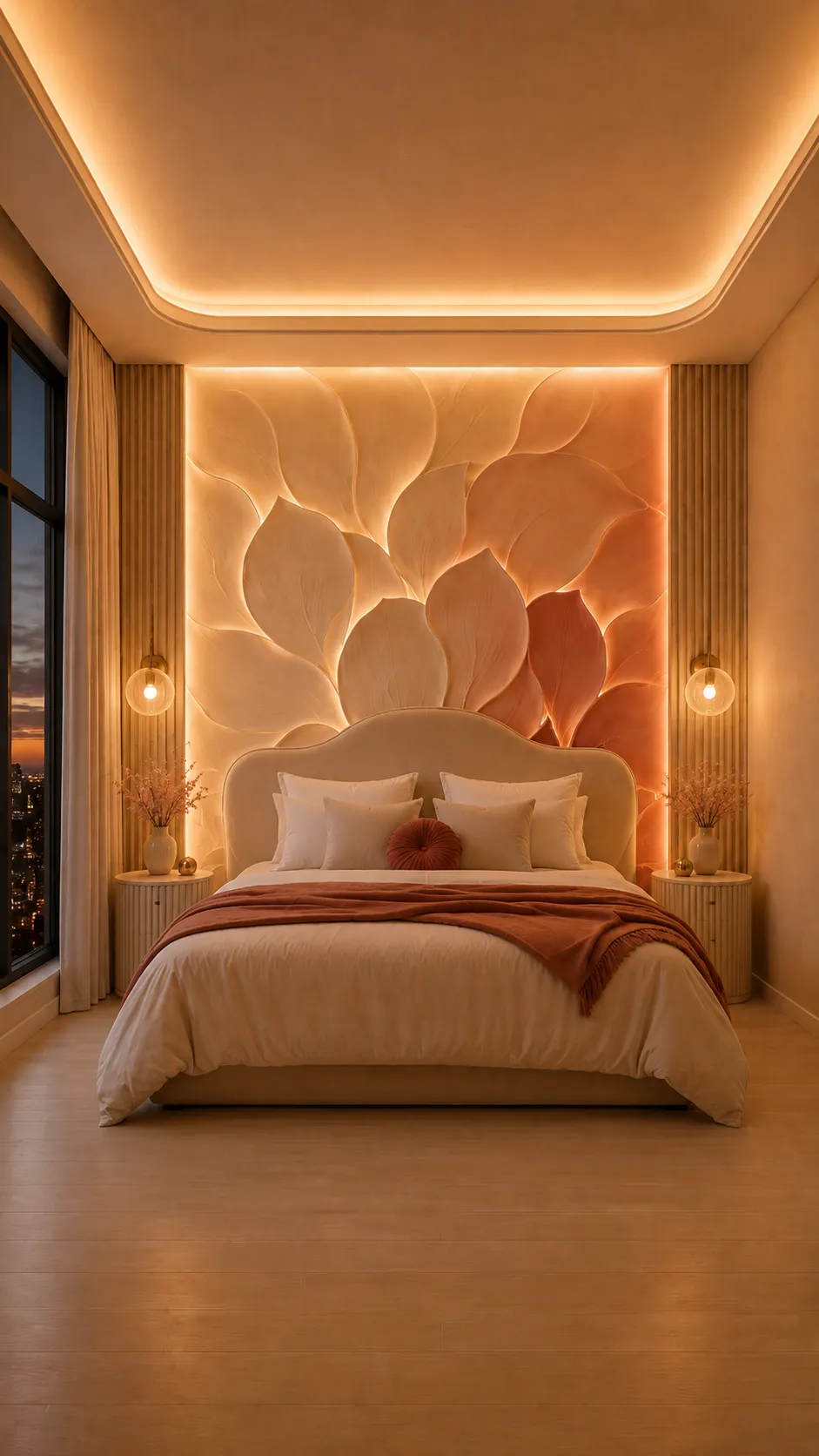
Bedroom with a backlit relief panel in a coral gradient
The headboard wall isn't a printed mural but a genuine relief panel: overlapping sculpted petals in a gradient running from cream to coral across the wall. And it's backlit around its whole perimeter rather than grazed from above, which is a decision and not a detail. Grazing light brings out texture; a perimeter halo brings out silhouette and colour. What this wall has to show is the gradient, so the halo won the argument and the relief stays deliberately soft.
DormitorioPanel de relieveRetroiluminaciónDegradado coralEstriado pintadoCabecero onduladoMesillas cilíndricasTerciopeloLuz de cornisaNoche
Design keys
A sculpted relief panel of overlapping petals, in a gradient from cream to coral across the wall.
Backlighting around the panel's entire perimeter, separating it from the wall so it floats.
Lighting chosen to bring out silhouette and colour rather than texture: there's no grazing spot on the relief.
Vertical fluting painted the wall's tone on both sides, with the sconces mounted onto it.
A scalloped headboard cropping the panel exactly where the petals begin to open.
Cylindrical fluted nightstands, with no corner to catch in the gap between bed and wall.
Furniture and decor in this design
5
Items shown are similar to those in the video, not necessarily identical.
Cylindrical fluted nightstand
A drum-shaped nightstand with a fluted front, in cream. Before buying, measure the diameter and compare it with the width of a square top: a forty-centimetre cylinder gives considerably less usable room than it appears to on a plan. It works when the light is on the wall; if it also has to carry a table lamp, there's no surface left for anything else.
A slim-armed sconce with a clear glass globe, mounted onto the fluted panel. Being clear, the bulb is fully visible: use a low-output filament and, if the sconce sits at head height when you're sitting up in bed, check the arm lets it turn toward the wall. Freeing the nightstand of a lamp is its real advantage in a bedroom with small bedside tables.
A headboard with a curved scalloped profile, plainly upholstered with no buttoning. In front of a shaped panel, a plain headboard is what stops two patterns competing: it contributes a silhouette and nothing else. Measure its height against what's behind, because a tall headboard can cover exactly the part of the panel worth showing, and that only becomes visible once it's in place.
A circular cushion with a sunken centre button, in terracotta velvet. It's the piece that breaks a row of rectangular cushions without adding another colour: it contributes shape rather than tone. One, in the centre, works; two at the sides turn it into another symmetry and it stops drawing the eye, which is the opposite of its purpose.
A terracotta velvet throw with fringed ends, laid across the foot of the bed. Velvet behaves differently from knit: it doesn't hold a fold and it slides, so lay it flat and tuck one side under the mattress if you want it to stay put. It pills where it rubs the duvet, so wash it inside out at a low temperature.
The panel is backlit around its perimeter rather than grazed from above, and that changes what you see. Grazing light picks out every ridge and turns relief into texture; a halo behind it cuts the outline and leaves the interior in soft light, which is what lets the colour gradient read across the wall.
The gradient runs from cream to coral left to right, and the window is on the pale side. With daylight coming in there, the panel reads softer by day and warmer at night: decide which way the gradient falls by first looking at where the light enters.
A relief panel arrives in pieces and the joints are finished by hand. Keep the joint layout away from the centre of the headboard, which is the point seen head-on, and make the joints coincide with the edge of a petal rather than crossing one through the middle.
A cylindrical nightstand has less usable surface than it appears. A round top loses the corners, which is exactly where the phone or the glass goes, and anything set near the edge overhangs: it works with a vase and little else.
The scalloped headboard crops the panel from below rather than overlapping it. Here it does so just where the petals begin to open; ten centimetres higher it would cover the point where the gradient changes tone, and the panel would lose half of what it has to show.
FAQ
Backlight a relief panel or graze it?
It depends what the panel has to show. If its value is texture — irregular relief, carved stone, a deep pattern — the light has to come grazing and from very close, because what draws it is the shadow each ridge throws onto the next. If its value is shape or colour, as here, grazing light gets in the way: it creates shadows that compete with the gradient. Then you backlight the perimeter, the panel cuts out against the wall, and the interior sits in soft even light. They're two different results, and it has to be decided before the cabling goes in.
What's the difference between a relief panel and a painted mural?
One has real volume and the other doesn't, and every practical difference follows from that. Relief casts its own shadow, so it changes through the day and depending on where you stand, while a mural looks the same always. In installation, the panel arrives in pieces that have to be jointed and finished by hand, and it's heavy; a mural goes up like wallpaper in a morning. And on cost and reversibility there's no comparison: removing a mural means scraping and painting, while removing a relief panel leaves the wall to be rebuilt.
Are round nightstands practical?
They have one clear advantage and a drawback you discover by using them. The advantage is circulation: with no corner there's nothing to catch in the gap between bed and wall, which is where you stub things at night. The drawback is usable surface: a round top of the same width as a square one loses a fair amount of room, and anything set near the edge overhangs and falls with a brush past. They work well when the lamp is on the wall, as here, and badly when a table lamp also has to fit.
Some links on this page are affiliate links. If you make a purchase through them, we may earn a commission at no extra cost to you.
 Bedroom
 Bedroom
 Bedroom
 Tu Casa