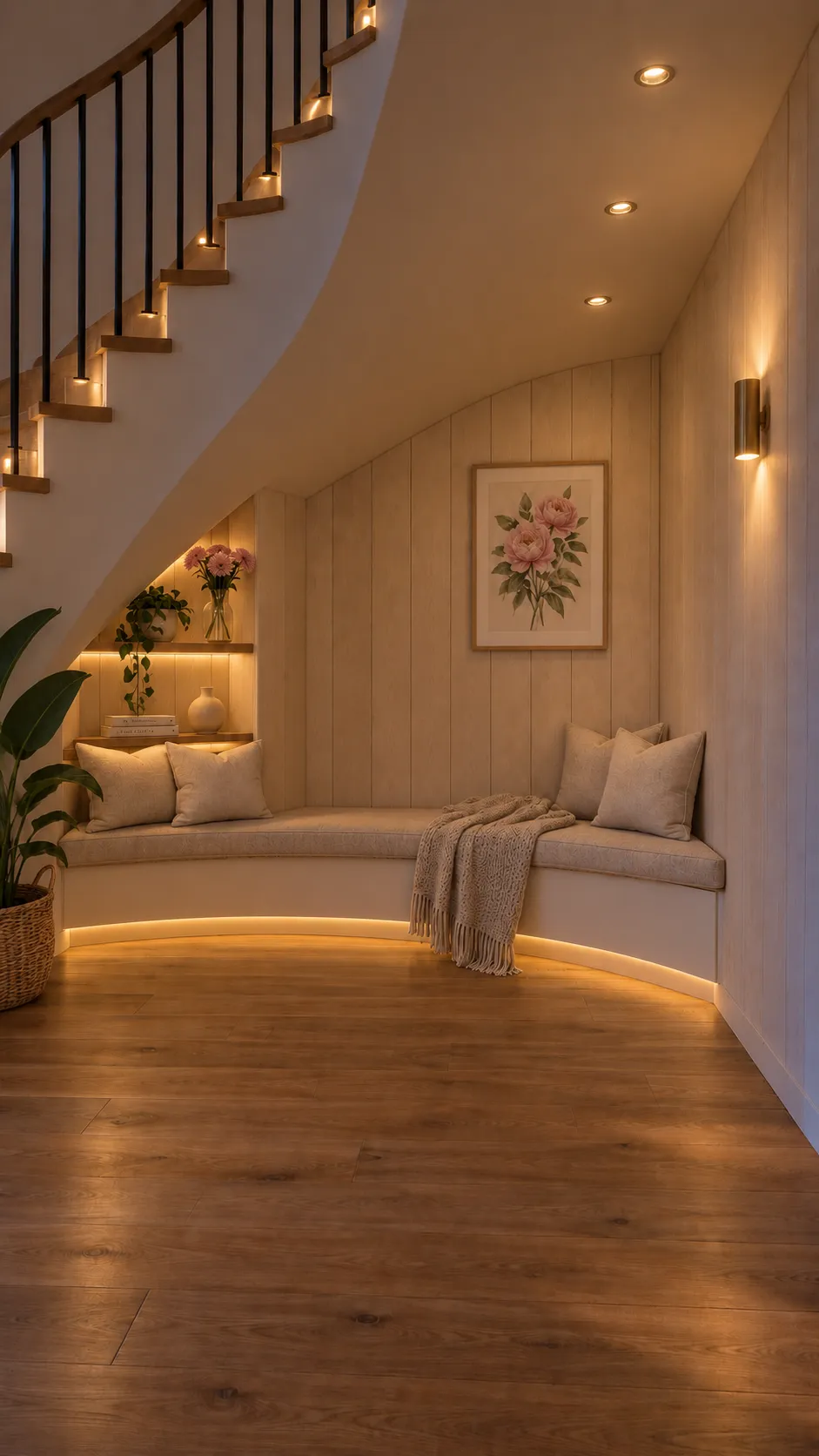
The void under a straight stair is a triangular prism and it's resolved with measurements; under a curved stair no two sections are alike and nothing from a catalogue fits. That's why everything here follows the curve: the bench, the lit plinth at floor level and the wall lining, which isn't a slat panel but tongue-and-groove boarding, narrow-board, the only thing that adapts to a wall that keeps turning.
Items shown are similar to those in the video, not necessarily identical.
Narrow board with tongue and groove on the edges, fitted piece by piece and closing the surface with no gaps. It's what lets you clad a curved wall, where a slat panel on a rigid backing won't go: the narrower the board, the tighter the radius it takes. Paint it before fitting if it's going in colour, because as the timber shrinks in winter an unpainted strip appears at every joint.
See similar on Amazon(paid link)Board grooved on one face that bends cold without breaking, for curved fronts on benches and bespoke furniture. It saves laminating two thin boards, though it still wants fixing over ribs cut to shape, because on its own it won't hold the radius. Check the minimum radius each product takes and which way it bends, because the grooves run in one direction only and fitted the other way it won't give.
See similar on Amazon(paid link)A foam sheet cut to the seat's template, essential when the bench is curved and no shop-bought cushion fits. The figure that decides is density rather than thickness: below thirty kilos per cubic metre it sinks within months where the same person always sits. For a bench you pass through, five centimetres is enough; for sitting a while, seven or eight.
See similar on Amazon(paid link)A comb of sliding pins pressed against an irregular shape to reproduce it, for transferring to timber a profile you can't measure with a tape. In a curved void it's what resolves the junctions against the wall and existing skirting without trial-and-error offcuts. Choose the long version with a lock, because short ones mean copying in sections and unlockable ones lose the shape as you pull them away.
See similar on Amazon(paid link)Skirting in polymer or kerfed MDF that bends around an arced wall, where a rigid one means cutting it into short lengths and leaving a joint every twenty centimetres. It's glued rather than nailed, so the wall must be sound and dust-free. Check the minimum radius before buying: polymer takes fairly tight curves while flexible MDF only handles generous ones.
See similar on Amazon(paid link)Some links on this page are affiliate links. If you make a purchase through them, we may earn a commission at no extra cost to you.
 Staircase
Orgánico Sereno
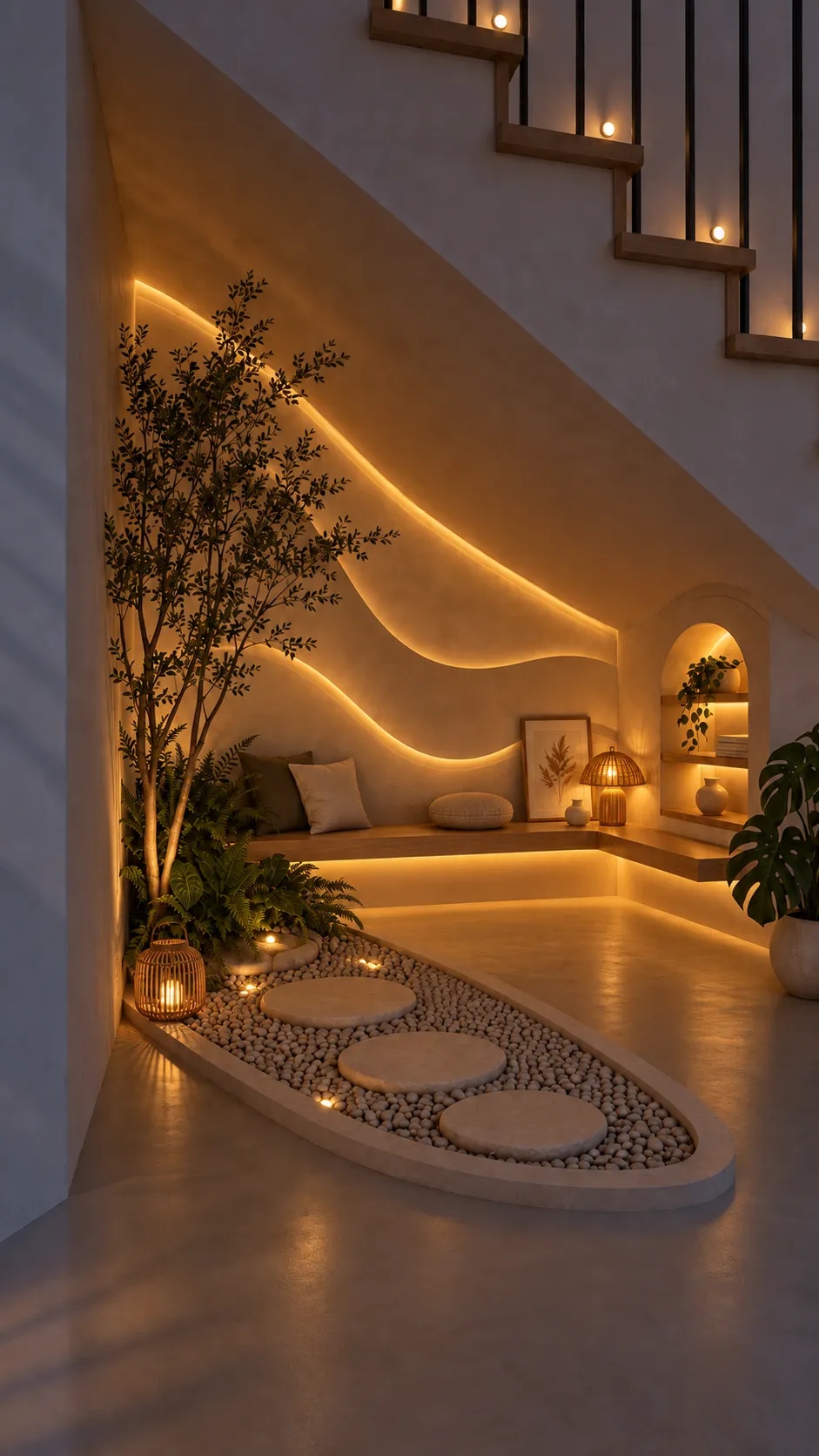
Bringing gravel indoors sounds like an indulgence until you see it resolved as it is here: an…
 Staircase
Boho Chic
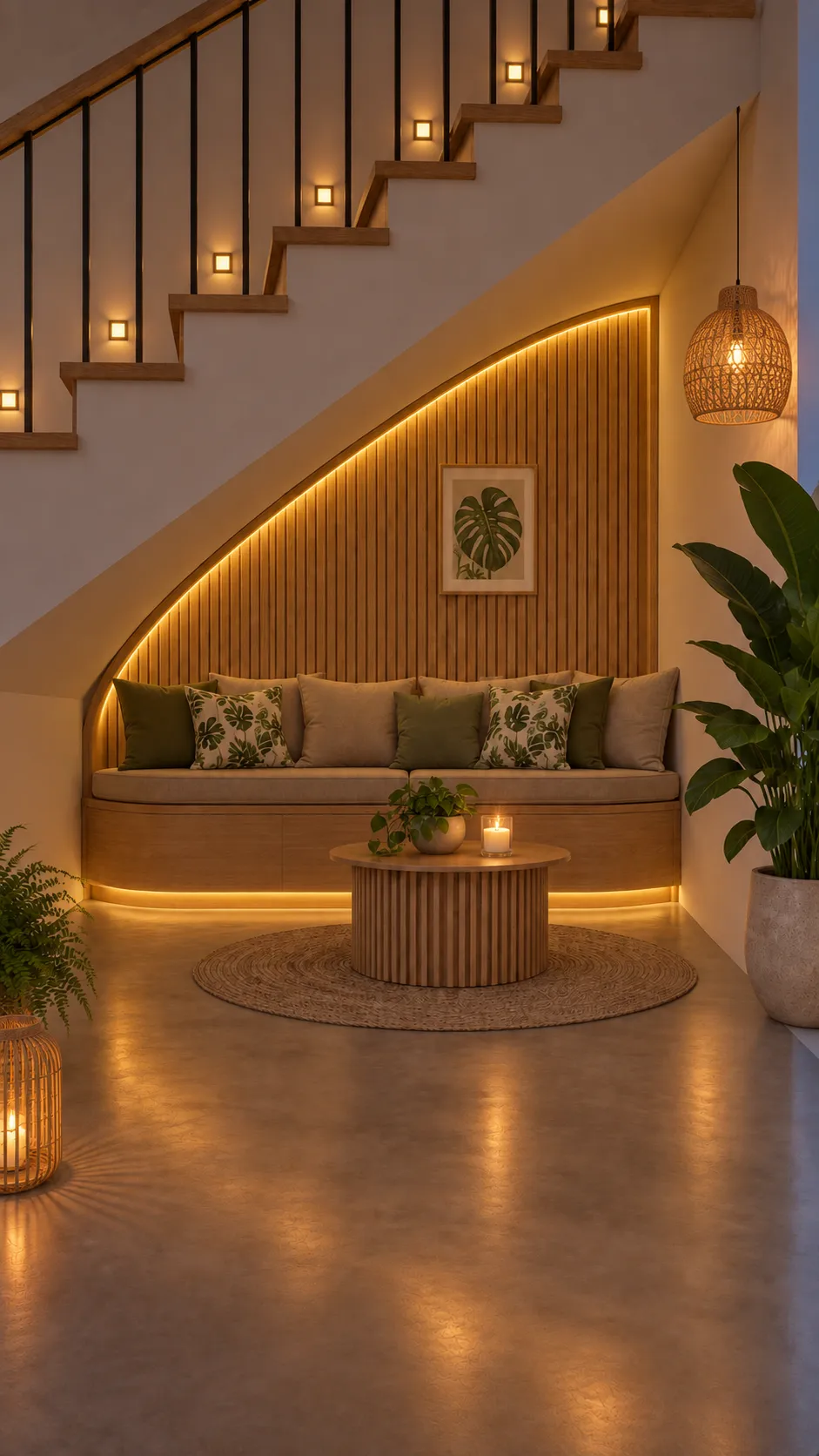
The space under the stairs stops being a leftover triangle and becomes the cosiest corner in the…
 Staircase
Contemporáneo
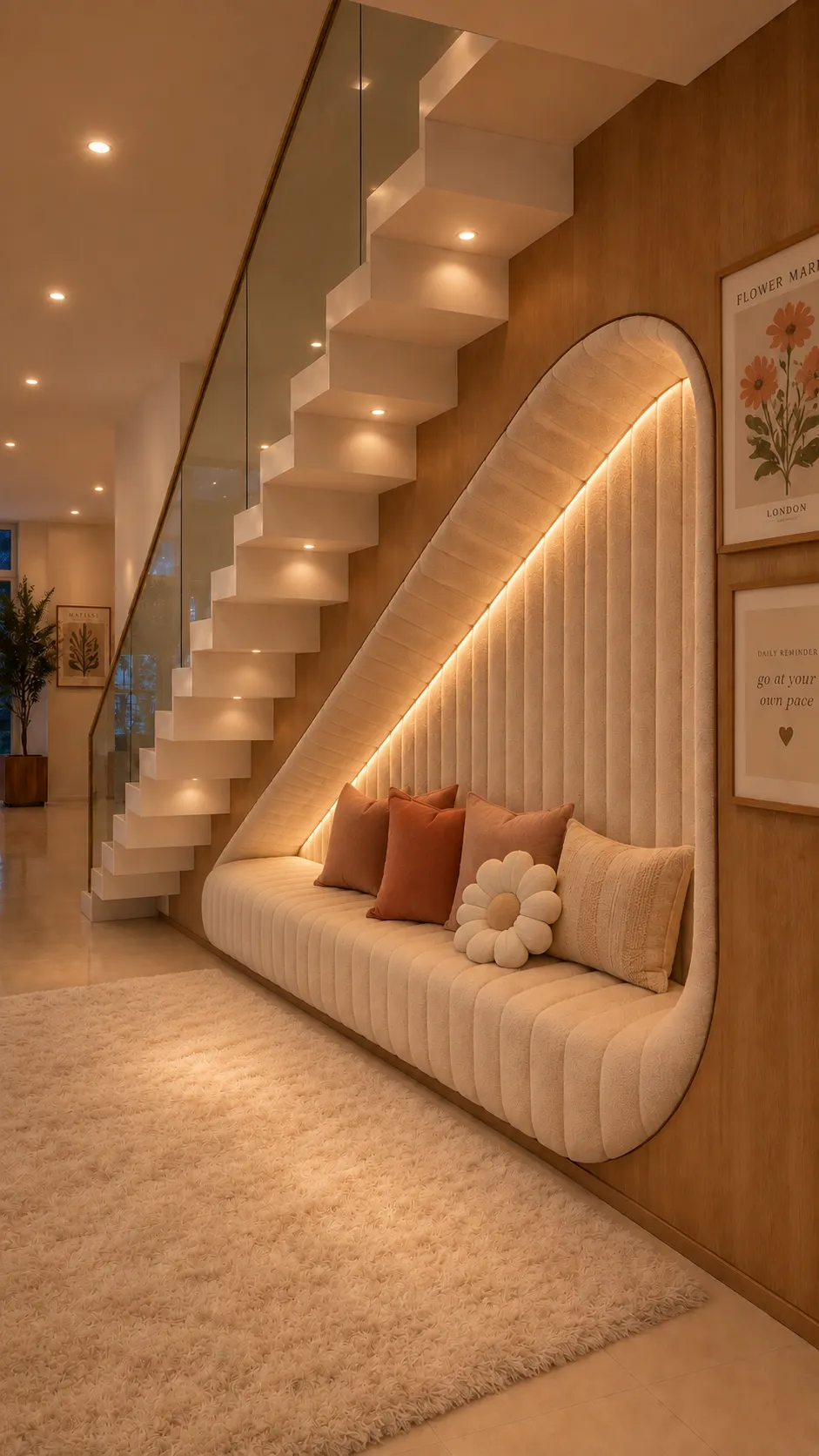
Here the space under the stairs isn't clad in timber — it's fully upholstered. Vertical channel…
 Tu Casa