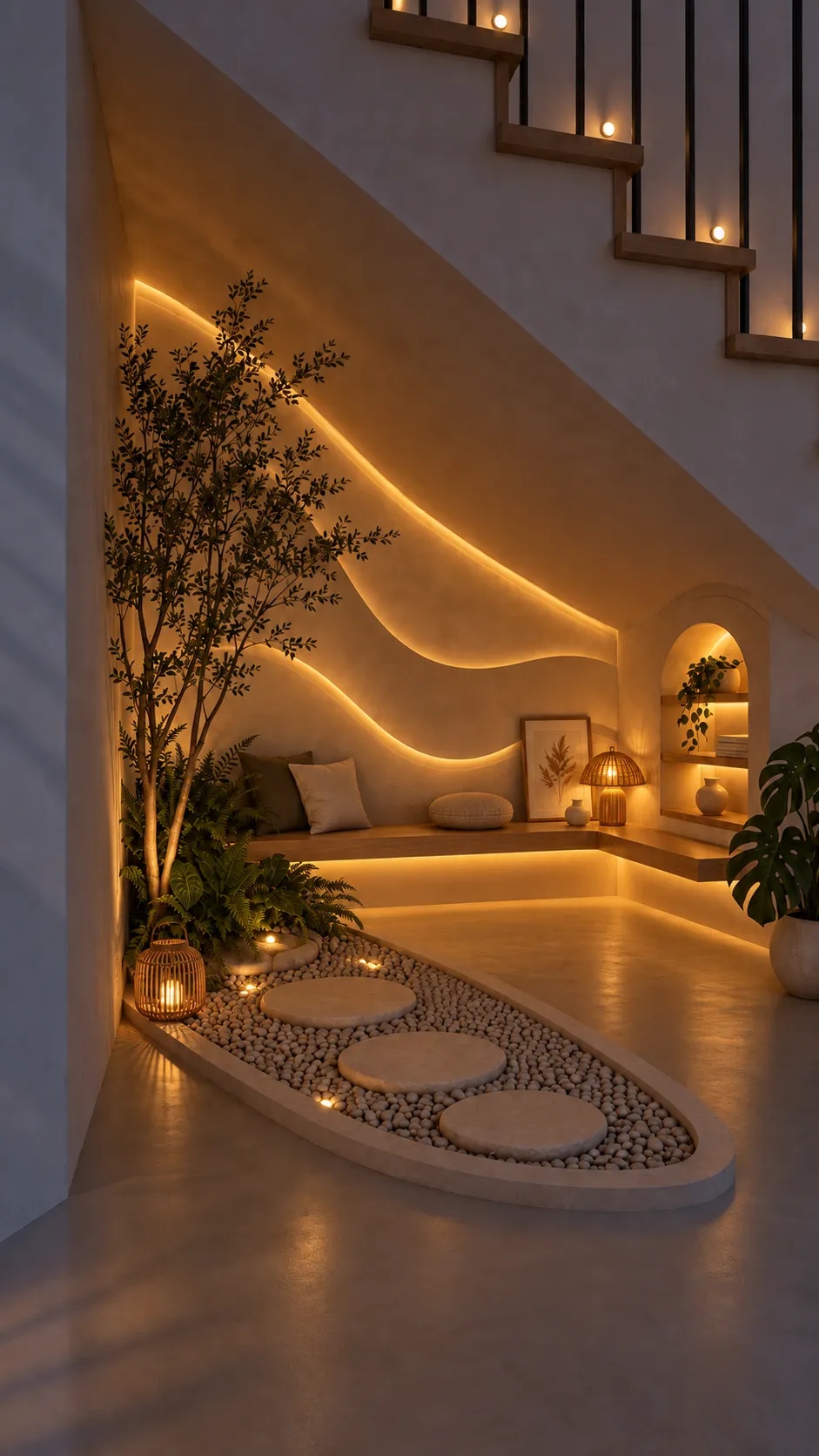
Bringing gravel indoors sounds like an indulgence until you see it resolved as it is here: an island closed by a continuous kerb, resting on the polished floor with three stone discs on top. The condition is that nobody walks across it. The corner's second decision is in the wall, where instead of a line of light there are three waves cut into the finish itself, each with its strip hidden inside and not a bulb in sight.
Items shown are similar to those in the video, not necessarily identical.
A metre-and-a-half or two-metre specimen for a corner where there isn't enough light for a living one. What separates a convincing one from a poor one is the trunk and the foliage: a natural wood trunk with its bark, and a canopy with leaves in several sizes and shades rather than all identical. Check the base too, because many come with a plaster block that has to be hidden inside a wide-mouthed planter.
See similar on Amazon(paid link)A fine-fibre or microfibre duster with a long handle, which is what reaches the top of a tree without climbing anything. Dust gives an artificial plant away long before its shape does, because it leaves the leaf matt and without the sheen a living one has. For a tall canopy a duster beats a cloth: a cloth means going leaf by leaf and nobody does that twice.
See similar on Amazon(paid link)A continuous low-profile edging for closing a gravel island on a finished floor. It wants to be a single bendable piece rather than straight sections bolted together, because on an oval shape every joint is a point where stone escapes. The right height is the depth of the gravel plus a finger: lower and it won't hold, higher and it becomes a step people trip on.
See similar on Amazon(paid link)A thick cushion for sitting straight on the floor or for leaving on a built-in bench as a loose seat. In an under-stair void it solves the height problem: where the ceiling drops there's no room for a chair, but there is for someone sitting on the floor. Choose one with a removable cover and firm filling, because a soft one flattens within weeks and stops being usable as a seat.
See similar on Amazon(paid link)A continuous finish a few millimetres thick applied over what's already there, and what lets floor and wall be the same surface with no joint at all. Over a curved form it's practically the only finish that doesn't force you to cut pieces. Budget for the sealing: without the final protective coat it stains from any liquid, and that coat needs renewing every few years in circulation areas.
See similar on Amazon(paid link)Some links on this page are affiliate links. If you make a purchase through them, we may earn a commission at no extra cost to you.
 Staircase
Nórdico Suave
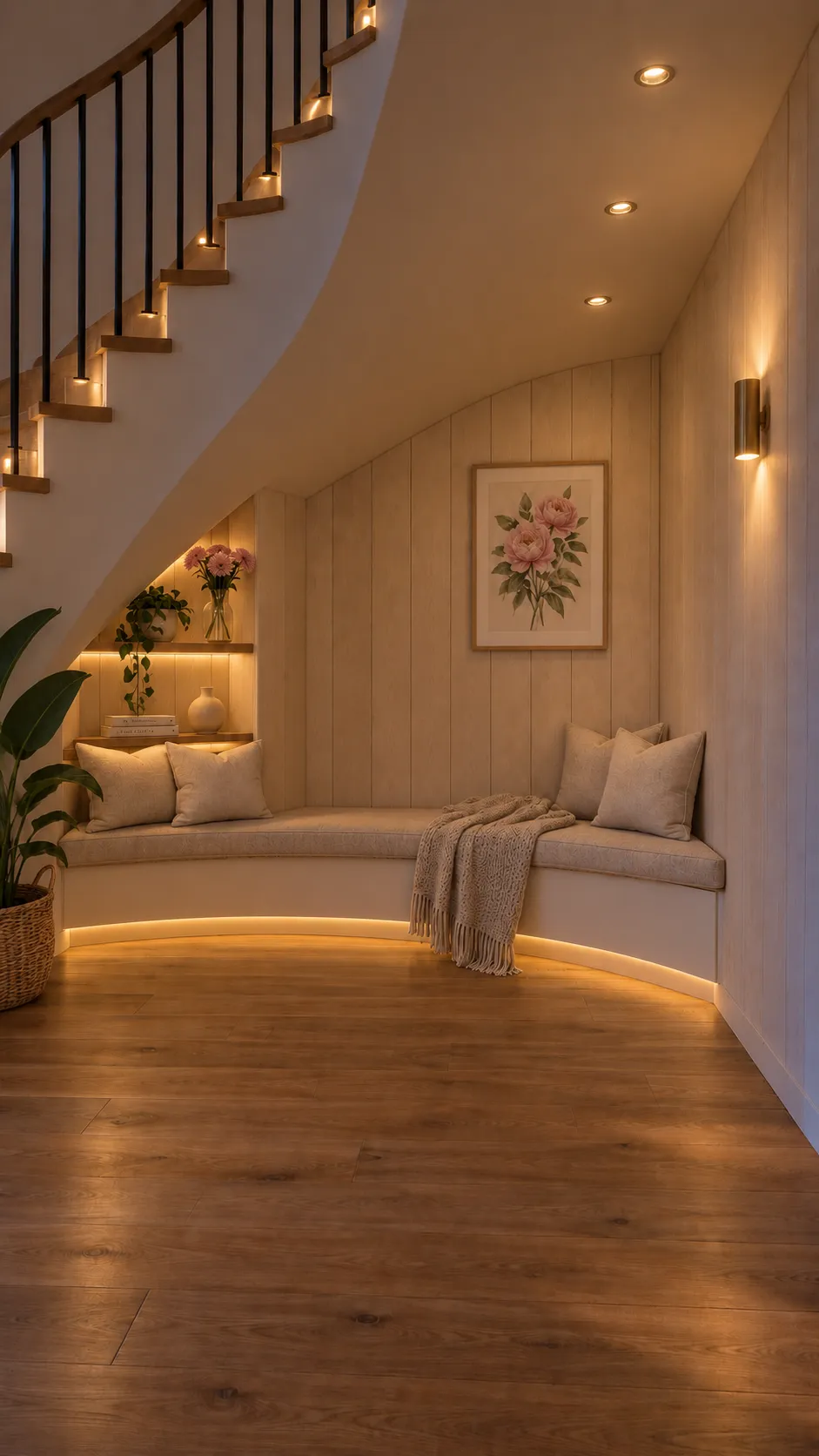
The void under a straight stair is a triangular prism and it's resolved with measurements; under a…
 Staircase
Boho Chic
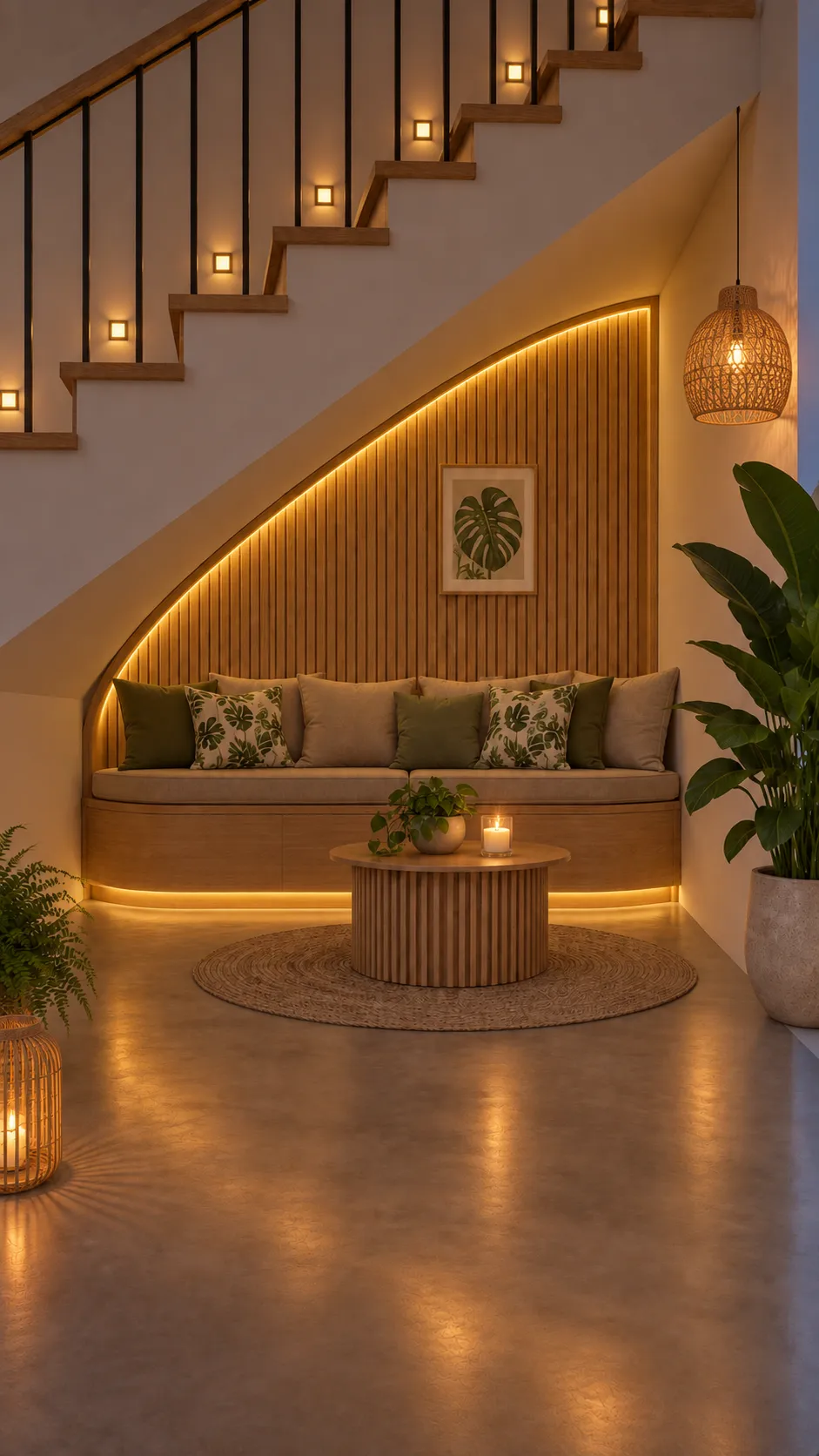
The space under the stairs stops being a leftover triangle and becomes the cosiest corner in the…
 Staircase
Contemporáneo
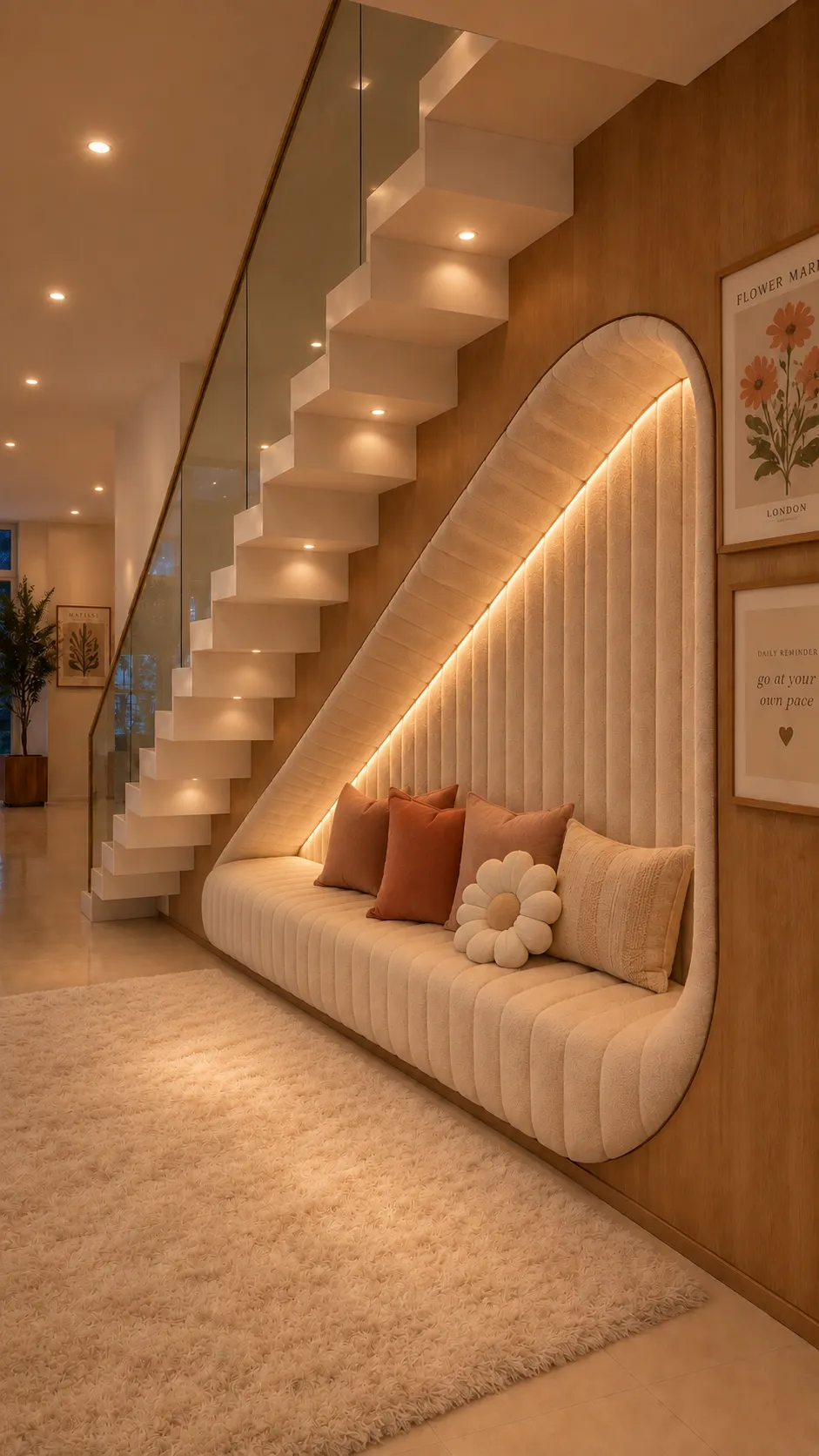
Here the space under the stairs isn't clad in timber — it's fully upholstered. Vertical channel…
 Tu Casa