✨Interior images are AI-generated. Items shown are similar to those in the video.
Lujo Sereno
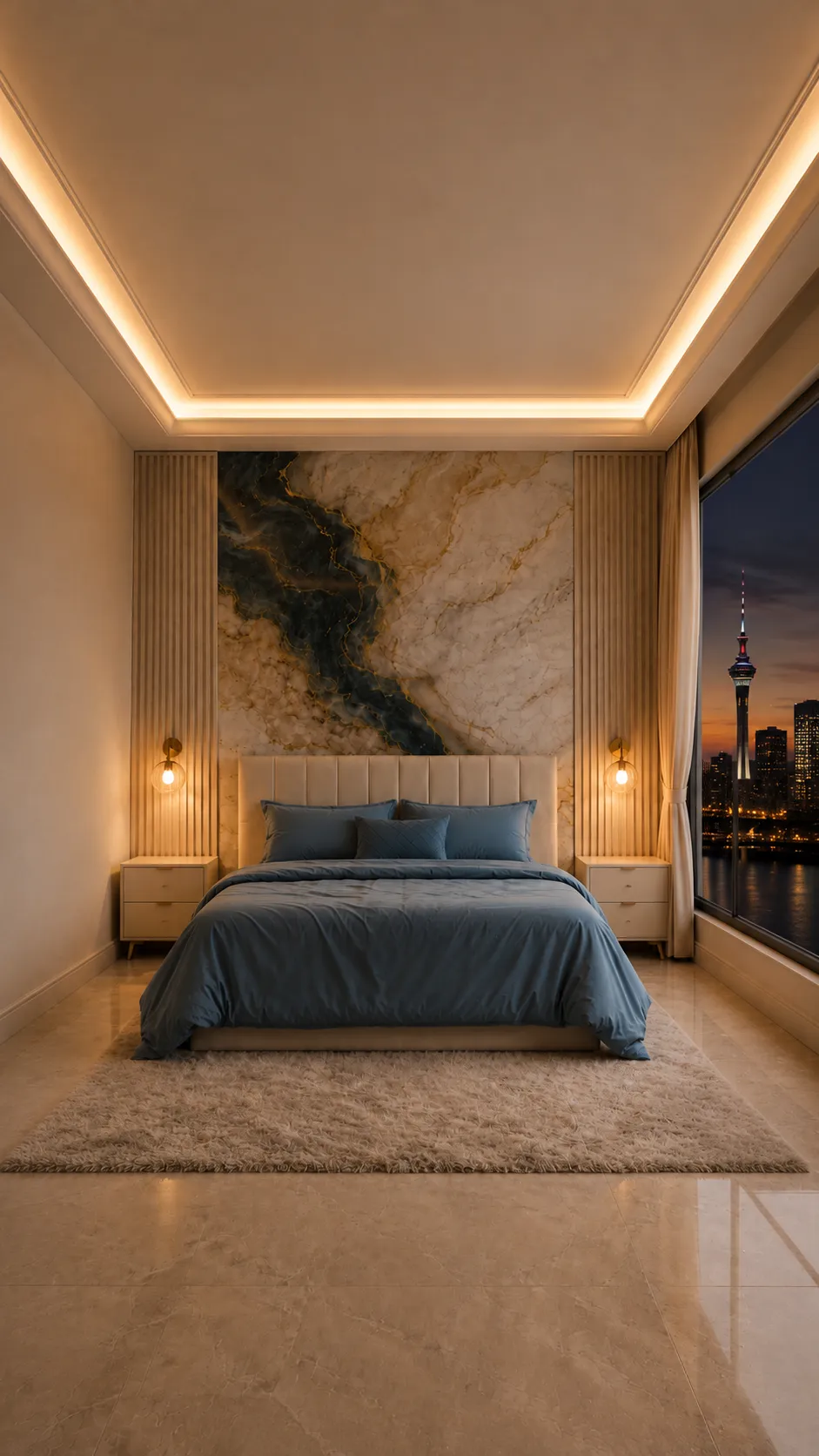
Bedroom with a veined marble panel and fluted side bands
With a stone panel behind the bed you aren't choosing a material, you're choosing one particular piece. Two slabs of the same marble have different veining, and the one crossing this wall diagonally can't be ordered from a catalogue: you have to go and look at it. That reverses the order of work compared with wallpaper, where the image is made to measure. Here the stone is a given and it's the headboard and the fluted bands that are arranged around it.
Panel de mármolVeteado a libroPorcelánico de gran formatoEstriado verticalCabecero canaladoAplique de latónCornisa de luzAzul y cremaVistas a la ciudadDormitorio
Design keys
A large-format slab with the vein crossing the wall diagonally, chosen for that specific piece's figure rather than the type of stone.
Vertical fluted bands at the sides, the only plain-coloured surfaces against the slab's figure.
Wall lights mounted directly on the fluting, their beams grazing the grooves upwards and downwards.
A vertically channelled headboard, with the same rhythm as the side fluting but at a different scale.
Blue bed linen as the only cool colour, which is what stops the whole room settling into cream.
A warm perimeter cove and not a single light fitting in the plane of the ceiling.
Furniture and decor in this design
5
Items shown are similar to those in the video, not necessarily identical.
Marble-effect large-format porcelain panel
A thin porcelain slab with printed veining, in formats up to three metres, letting you cover the headboard wall in one piece with no joints. Weighing around a third of natural stone, it can be bonded to an ordinary partition. Before buying, ask to see a photo of the complete piece rather than a twenty-centimetre sample: the veining on these slabs is designed at wall scale and a small offcut tells you nothing about the result.
A panel with the groove routed into the board itself and lacquered at the factory, which is what separates fluting from applied slats: there are no loose pieces and the bottom of the valley is the same colour as the ridge. Factory lacquer saves the problem of painting the valleys, which a roller can't reach and a spray gun needs a booth for. Check the groove radius, because the tighter it is the more shadow it casts and the harder it is to dust.
A disc or plate fixed to the wall first, giving the fitting's base a flat surface and solving the problem of bearing on a grooved face. Choose it in the same metal as the light so it reads as part of the fitting rather than a patch. Check it has a centred cable entry and through-bolts, because plates intended only as cover trims won't carry the weight of a brass wall light.
A suction cup with a hand pump and gauge for gripping a porcelain slab without touching the edges, which is where it breaks. A large piece can't be handled bare-handed or by two people without lifters: it flexes under its own weight and snaps in the middle. For formats over two metres you need several cups on a frame rather than one on its own, and check the surface is clean, because with dust the cup loses vacuum without warning.
Wedge clips that hold two pieces at the same height while the adhesive sets, essential in large formats because a millimetre of step between slabs shows in raking light across the whole wall. Budget for far more than you'd think: on big formats they go every twenty or thirty centimetres along the entire joint, not just at corners. Reusable wedge systems work out better than disposable clips on a large job.
Go and see the slab before buying and ask to have it shown upright and whole. In the yard they stand in racks and you look up close, but what matters is the figure from three metres: veining that looks beautiful close to can end up centred exactly where the pillow goes and never be seen.
Mark on the slab where the headboard will sit before cutting it. With a metre-high headboard you lose the lower third of the wall, so the good part of the veining has to fall above that line or you're paying for stone nobody will see.
Wall lights don't screw straight onto fluting. The fitting's flat base rests on only two or three ridges and ends up rocking, so you need a mounting plate or a piece of flat panel let in at that point, planned before the fluting goes up.
Have the wiring pulled through before fitting the fluted panel. Drilling afterwards is what breaks it: between grooves the material is thin, the bit wanders into the valley and a piece of ridge breaks away that can't be replaced.
With a figured slab, keep the two side bands plain in colour. Fluting brings texture without adding any pattern, and that's what lets the stone be the only thing you look at on that wall.
FAQ
What is book-matching and when is it worth it?
It means laying two slabs cut one behind the other from the same block, opening them like the pages of a book, so the veins are symmetrical about the central joint and draw a kind of butterfly. The effect is spectacular and has one condition that makes it expensive: the two pieces must be consecutive from the same block, so they have to be bought as a pair and can't be obtained separately later. One detail decides whether it's worth it in a bedroom: all the drama is on the axis of symmetry, and if the headboard covers precisely that central strip, you pay double for an effect that stays hidden. With a tall headboard a single slab with a crossing vein, like this wall, usually earns its keep better and costs considerably less.
Natural marble or large-format porcelain on a wall?
The practical difference is weight and repetition. A twenty-millimetre marble slab comes to around fifty kilos per square metre and calls for mechanical fixing and a check on the substrate; six-millimetre porcelain sits at about fifteen and can be bonded to an ordinary partition. In exchange, porcelain carries a printed image: if the wall needs two pieces of the same model, the veining repeats identically and that repetition is spotted at once, whereas in natural stone no two slabs are alike. For a bedroom wall, with no water or acids involved, porcelain covers almost everything asked of it and avoids the periodic sealing that porous natural marble does need.
How do you mount a wall light on a fluted panel?
Not directly, because a fluted panel has no flat surface to bear on. A wall light's round base ends up touching only the ridges of two or three grooves, never seats properly and eventually rotates. There are three ways round it and all are decided before the panel goes up. The cleanest is letting in a piece of flat board in the same finish at that point, sized to the base. The second is fitting a visible rose or mounting plate, in the same tone or in the light's metal, acting as an intermediary. The third, only where the grooves are very shallow, is filling that stretch and sanding it before painting. What doesn't work is screwing onto the ridges and trusting the tightening: the material gives and the fitting works loose.
Some links on this page are affiliate links. If you make a purchase through them, we may earn a commission at no extra cost to you.
 Bedroom
 Bedroom
 Bedroom
 Tu Casa