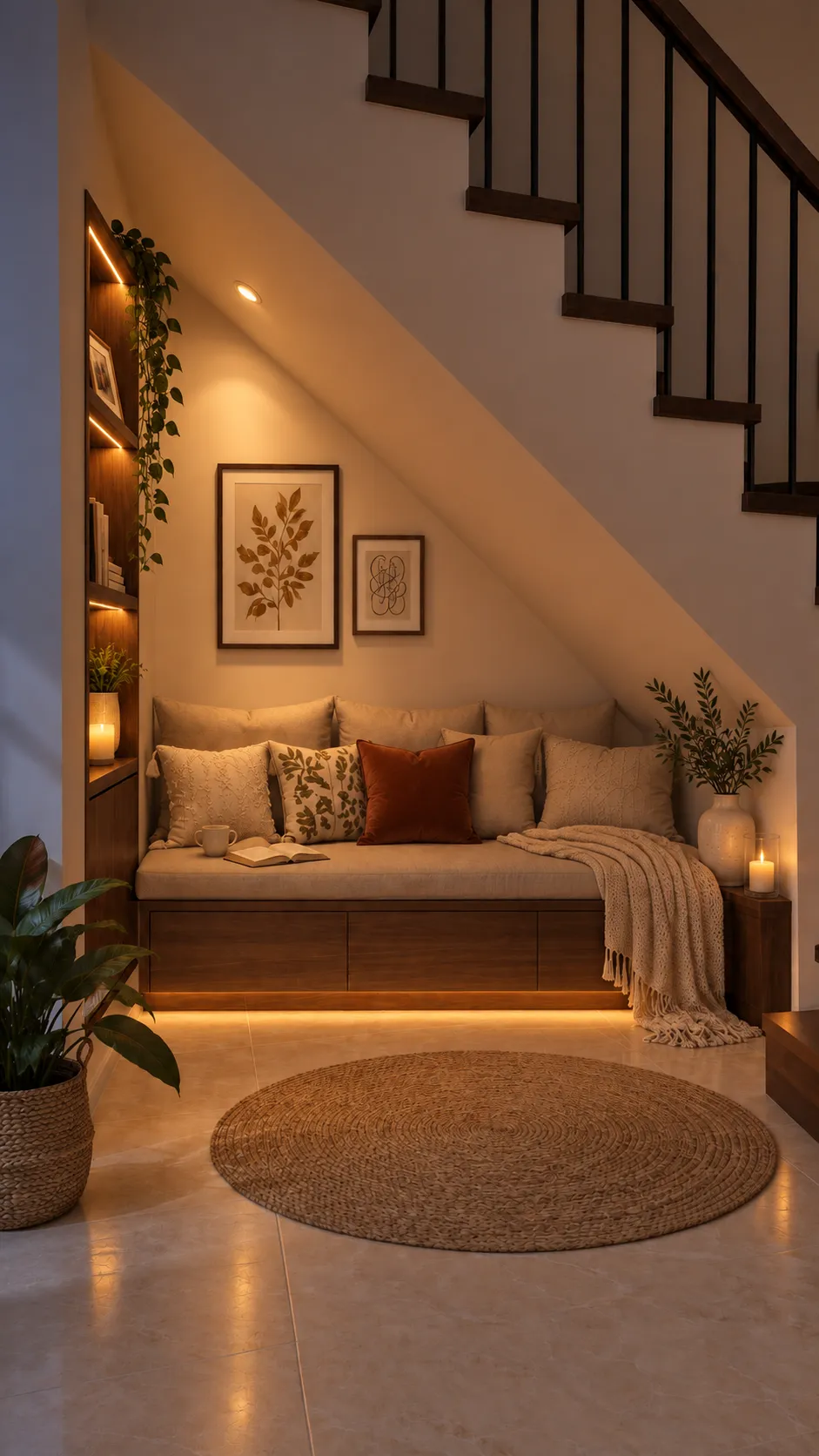
The two framed prints on the wall aren't equal or nearly equal: one is considerably larger than the other and they're aligned at the bottom, not the top. It's a small difference and it solves the usual problem, which is that two pieces of similar size hung together read as a measuring error. The rest of the corner is what you'd expect under a staircase — bench, drawers, concealed light — but with two things properly sized: the cushions and the shelf heights.
Items shown are similar to those in the video, not necessarily identical.
Paper sheets the size of each frame, taped to the wall to see the composition before drilling. They solve the problem of a pair of unequal pictures, where spacing and alignment are decided by looking rather than calculating. Some come with the hanger position printed, so the hole is drilled through the paper and the template comes away afterwards with no need to measure again.
See similar on Amazon(paid link)A feather or down inner, which is what separates a cushion that gets used from one that's only looked at. Siliconised fibre holds its shape but doesn't give, so it doesn't adapt when you lean on it and ends up pushed aside; feather sinks and recovers when plumped. Order the inner two or three centimetres larger than the cover, because if it's exactly the same size the cover wrinkles at the corners and the cushion looks half empty.
See similar on Amazon(paid link)A bracket or foot placed mid-span so a shelf doesn't sag under the weight of books. It's needed beyond seventy or eighty centimetres between supports on an eighteen-millimetre board, and sooner on thin melamine shelving. If you'd rather not see the support, the alternative is a steel flat bar let into a groove underneath, which stays invisible but has to be planned before the shelf goes up.
See similar on Amazon(paid link)A cover in a natural tone with the pattern worked into the fabric itself, bringing texture without introducing a new colour into a scheme of naturals. It's the piece that stops a bench of all-plain cushions reading flat. Check it has a zip rather than an envelope closure if it's for daily use: the envelope type opens as you lean on it and the inner ends up showing at the back.
See similar on Amazon(paid link)A pair of stops keeping books upright when the shelf isn't full, which is what stops them leaning over and warping their covers. The figure that matters is weight: thin sheet-metal ones slide as soon as there are two or three books, while those with a felt base grip without scratching the wood. On a shelf lit from beneath, choose a low profile, because a tall one cuts the line of light and casts its shadow across the spines.
See similar on Amazon(paid link)Some links on this page are affiliate links. If you make a purchase through them, we may earn a commission at no extra cost to you.
 Staircase
Mediterráneo Sereno
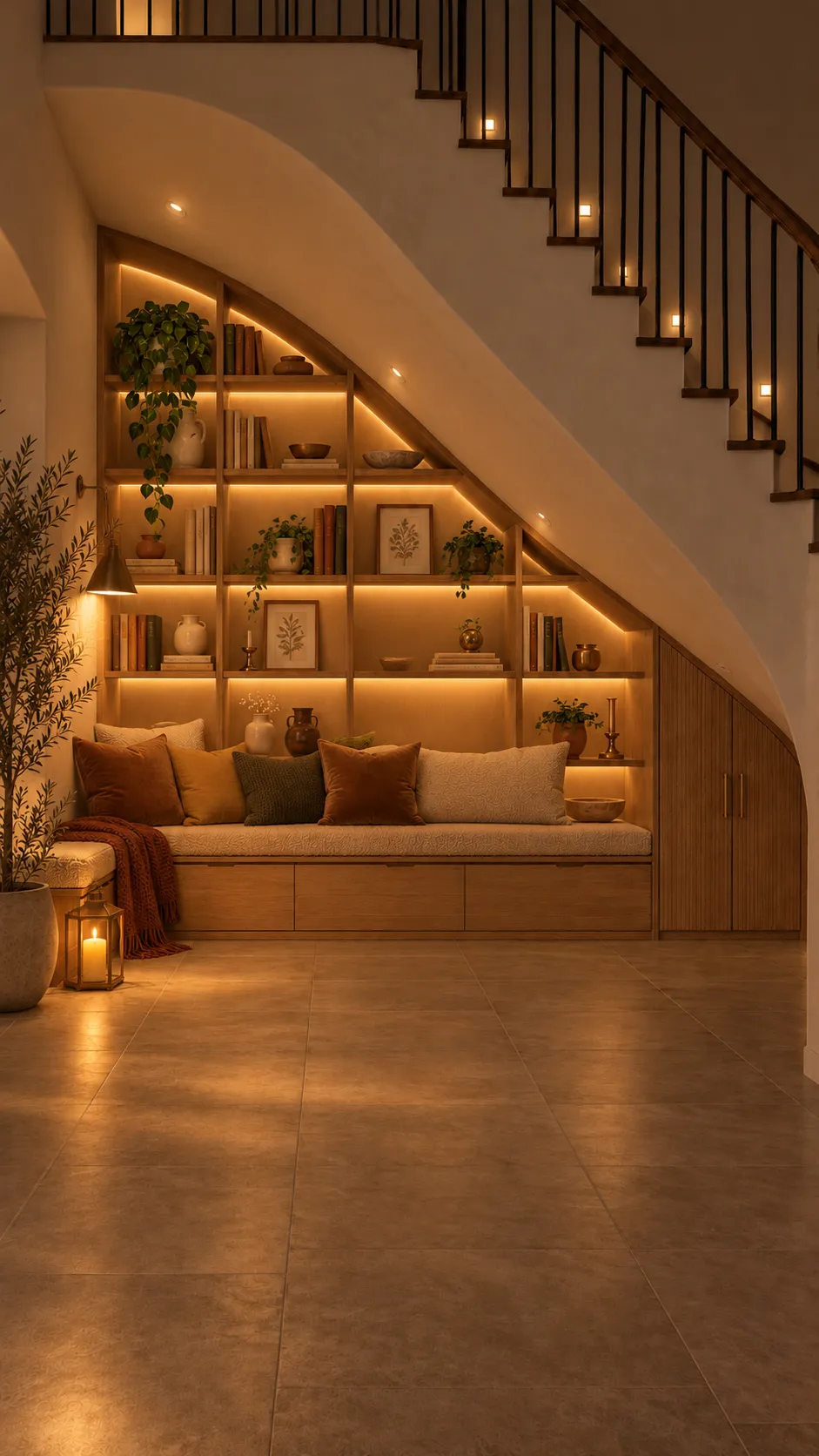
Under a curved staircase the ceiling does not come down in a straight line but describes an arc…
 Staircase
Lujo Cálido
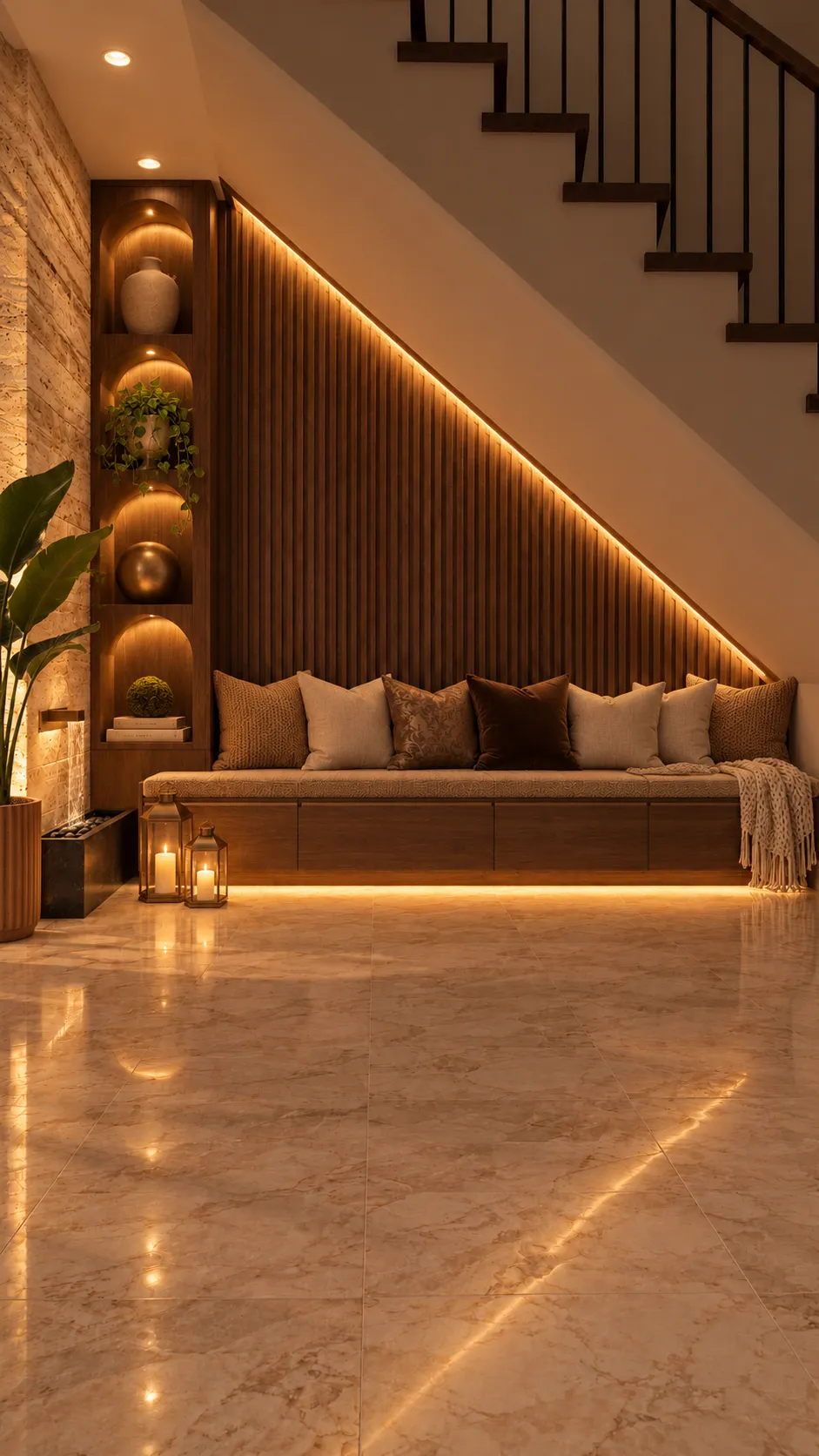
The slatted plane fills the whole triangle the staircase leaves, and along the top edge, right…
 Staircase
Natural Familiar
The dog's bed sits inside an arch cut into the staircase front, not against it. That difference…
 Tu Casa