✨Interior images are AI-generated. Items shown are similar to those in the video.
Mediterráneo Sereno
Bookcase under a curved staircase: setting out the grid
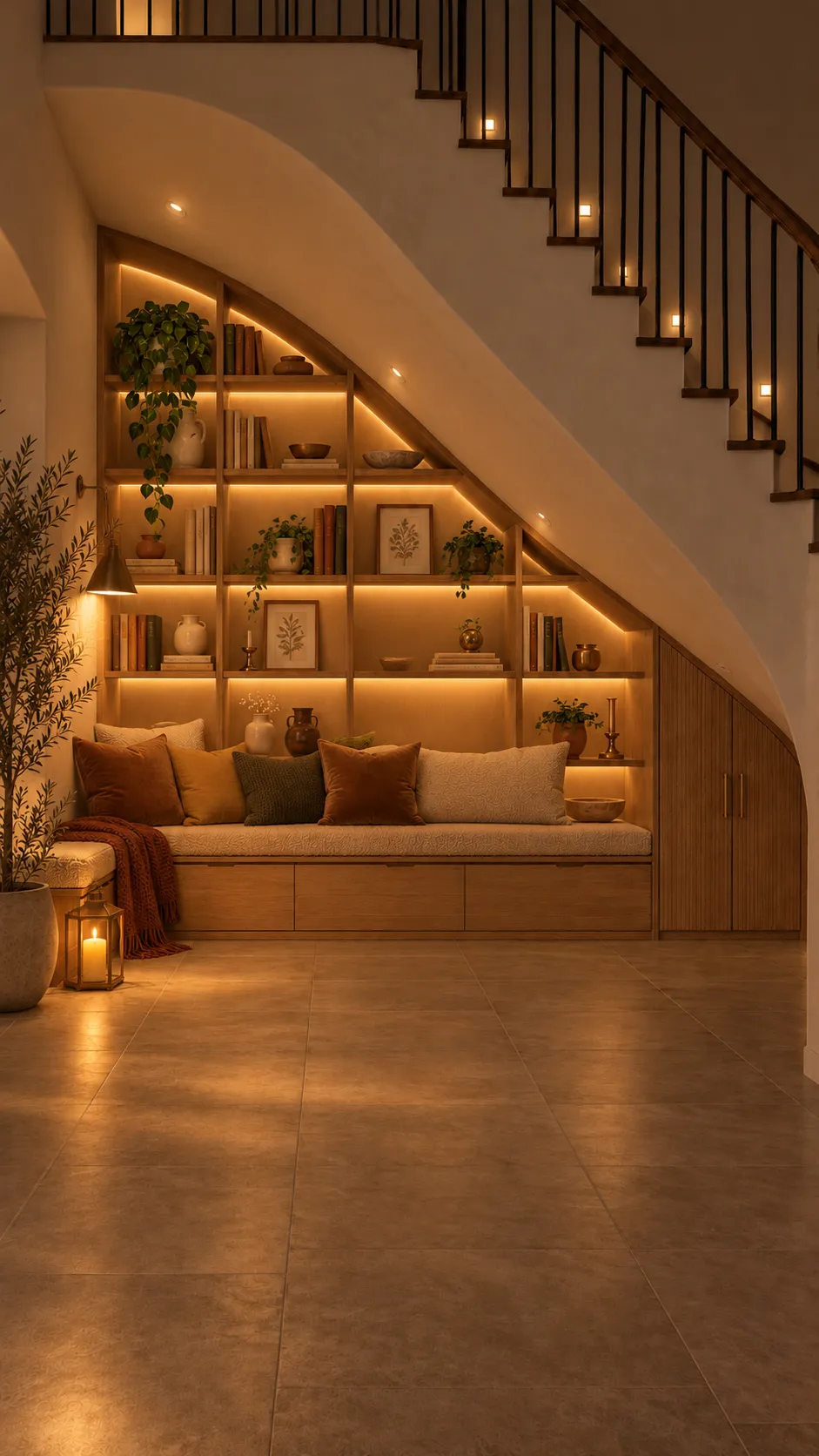
Under a curved staircase the ceiling does not come down in a straight line but describes an arc, and that is where nearly every fitted bookcase fails. Draw a regular grid and cut it against the curve and you get mutilated compartments at the edge; adapt every compartment to the curve and each shelf measures differently and the whole thing looks improvised. It has been resolved here with a simple rule: the shelves stay horizontal and what changes is where each one stops.
Librería bajo escaleraRetícula de huecosEscalera curvaMontantes verticalesBaldas iluminadasBanco con cajonesArmario acanaladoLuces en la barandillaCojines tejaRincón de lectura
Design keys
A grid of horizontal shelves at fixed levels, each stopping where the staircase's curve reaches it.
Vertical uprights aligned with one another top to bottom, which give order once shelves change length.
A strip of light under each shelf, following the grid and accompanying the arc with a stepped line.
A continuous bench at the base with two deep drawers, built into the same setting-out as the bookcase.
A fluted-front cupboard at the low end, where the curve leaves insufficient height for shelves.
Square lights recessed into the staircase wall, lighting the treads from the side.
Furniture and decor in this design
5
Items shown are similar to those in the video, not necessarily identical.
Oak shelf for a fitted bookcase
Oak board for the shelves of an under-stair bookcase, with solid edging on the visible face. For books, twenty-five centimetres deep and two thick: any thinner and a shelf over eighty centimetres bows in the middle within a year. If a compartment is to be longer, add an intermediate upright rather than increasing the thickness.
A narrow profile with a matt diffuser to rout into each shelf's front edge. The matt diffuser is not optional in a bookcase: with a clear one, the strip reflects dot by dot in books' satin spines. Run the supply through a vertical upright rather than the back, so the driver can be reached without emptying the shelves.
A runner letting the drawer come right out, essential on deep drawers under a bench seat. With a partial runner, the drawer's last third stays inside the carcass and that is exactly where the things you cannot find end up. Check the load rating in kilos: a metre-long drawer under a bench fills with blankets and weighs more than it looks.
Fluted-front doors for closing the low end of an under-stair bookcase, where the curve no longer leaves height for shelves. If the front has to follow the curve, order flexible panel and check the minimum radius it accepts. And decide the hand of opening by looking at the walkway: at the narrow end of an under-stair void, a leaf opening outwards blocks the route.
A square marker to recess into the staircase's side wall, at tread height rather than skirting height. Fit one every three steps and check the back box fits the partition: in a loadbearing wall you have to pick a surface model. Choose warm light aimed at the step, because a marker pointing straight out dazzles on the way down.
Keep the shelves horizontal and at constant levels. What makes a bookcase under a curve legible is not every compartment being equal but the horizontal lines staying horizontal: what varies is each one's length.
Align the vertical uprights across every row. They are the structure and also what orders the eye: if each row has its divisions in different places, the grid turns into a puzzle however perfect the shelves.
Close the low end with doors rather than small shelves. Where the curve leaves less than thirty centimetres of height a book will not stand, and a row of tiny compartments at the end is what gives away that the grid did not work out.
Fit the light under each shelf's front edge, not at the back. That lights the shelf below and the line of light draws the grid; at the back, all you achieve is a halo behind the books.
Make the row at seat level taller than the rest. It is the one seen sitting down and the one that ends up taking large pieces, ceramics and baskets; the same height as those above and that row fills with things lying flat.
FAQ
How do you set out a bookcase under a curved staircase?
By fixing the shelf levels and letting the length vary, never the other way round. The usual mistake is trying to make every compartment equal: as the ceiling describes an arc, keeping equal compartments means tilting or stepping the shelves, and the result reads as a joinery error. What works is treating the curve as a limit rather than a guide. You draw a regular grid on the elevation, with shelves at constant levels and uprights aligned vertically, and then cut that grid against the staircase's line: each shelf runs as far as it can and stops. That way the horizontals stay horizontal and the curve appears as the whole's profile. Two finishing rules. The vertical uprights have to coincide across every row, because they are what orders the eye. And the smallest resulting compartment must still be useful: below about twenty centimetres, better to remove it and lengthen the one beside it.
What height should bookcase compartments be?
Twenty-eight to thirty-five centimetres clear for normal books, and one row is worth devoting to something taller. Most paperbacks and novels are eighteen to twenty-four centimetres, so a thirty-centimetre compartment leaves room to pull them out without scraping the shelf above. The problem comes with large books, art and photography ones, which pass thirty: with no single tall row they end up lying on top of the others, and that is what gives an otherwise perfect bookcase an untidy look. The practical answer is making the row at seat level, or the lowest of all, around forty centimetres. As for depth, twenty-five to twenty-eight centimetres is plenty for books; more depth gains no useful capacity and does create a second plane behind where things get lost.
Lit shelves or one spotlight for the whole bookcase?
Lit shelves, in an under-stair bookcase nearly always. A general fitting on the room's ceiling enters the compartments very unevenly: high shelves get light and low ones stay in shadow, because the shelf itself acts as a visor. Besides, in an under-stair void there is rarely usable ceiling above to hang anything from. A strip under each shelf's front edge resolves both, because it lights the shelf below from above and incidentally draws the grid, which on a bookcase cut against a curve is exactly what you want to underline. Three precautions. Use a profile with a matt diffuser, because a bare strip reflects in books' satin spines. Connect every row to the same dimmer. And run the supply through an upright rather than the back, so you do not have to empty the shelves if it ever fails.
Some links on this page are affiliate links. If you make a purchase through them, we may earn a commission at no extra cost to you.
 Staircase
 Staircase
 Staircase
 Tu Casa