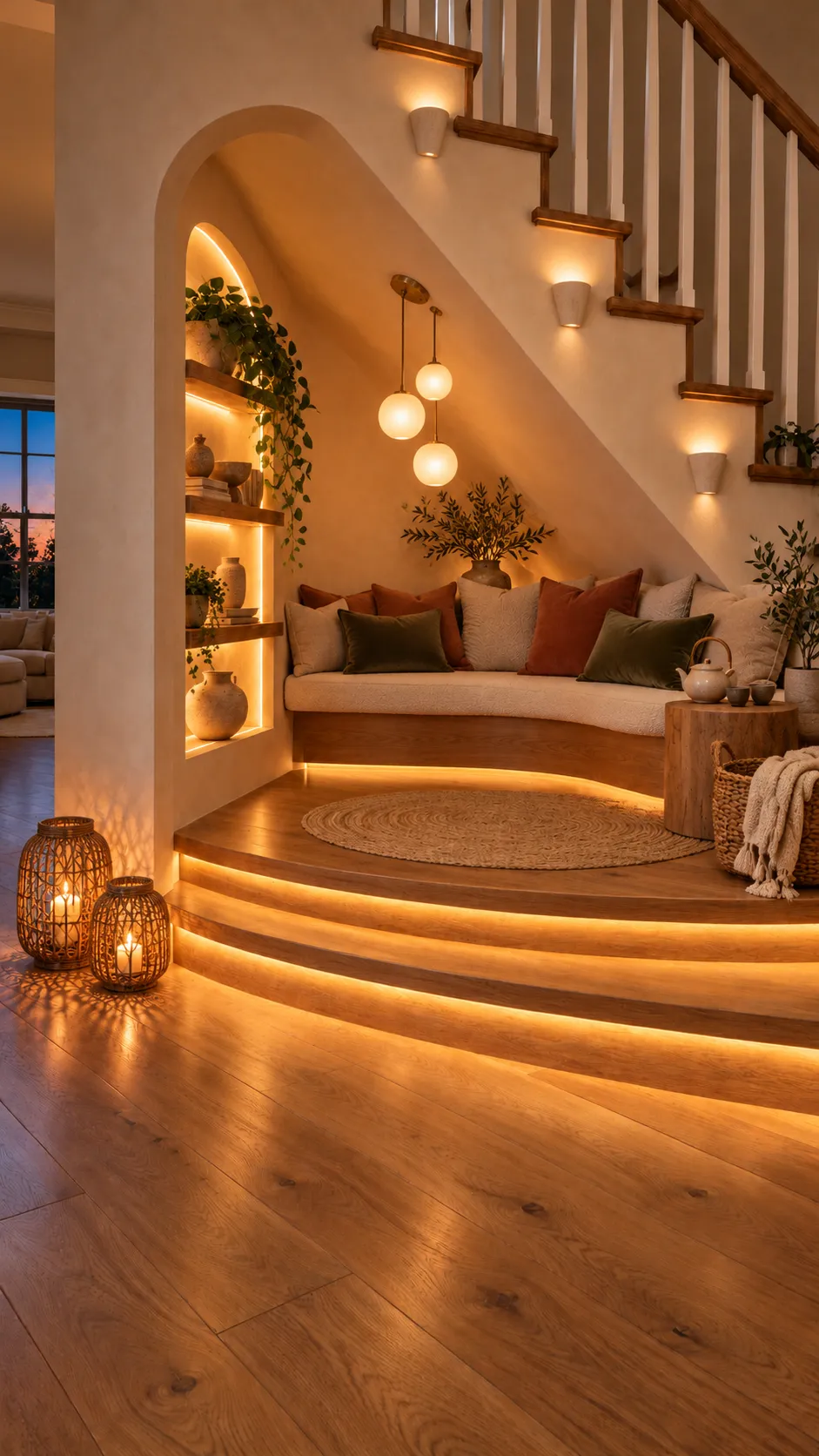
The corner sits two steps above the living room, and those two steps are the most dangerous thing in the house. Not because they are high, but the opposite: a small level change is not expected. It has been resolved the only way that really works, which is making it impossible not to see: every riser carries a line of light, the steps are curved and spill out into the room, and the whole thing reads as a platform rather than a trip.
Items shown are similar to those in the video, not necessarily identical.
A profile with a diffuser to recess into a step's vertical edge, where the light warns of the level change. Pick one with an opal diffuser and flush mounting: a profile standing proud of the riser becomes the very edge your foot catches. Measure a curved step's real width along its outer development, which is always longer than it looks on the drawing.
See similar on Amazon(paid link)A fitting throwing light at ceiling and floor without showing the bulb, the only kind that does not dazzle coming down a staircase. Install it measuring from the tread beneath it rather than from the lower floor. Check the wall's junction box lines up with the backplate: on a staircase, moving a light point means chasing the plaster.
See similar on Amazon(paid link)A set of three globes on cables of differing length from one ceiling rose, filling vertically the tall void beside a staircase. Hang it over the bench and not over the walkway, and check its lowest point against the height of somebody standing on the top step: the relevant level is the platform's, not the floor's.
See similar on Amazon(paid link)A tall lantern with a pierced body, casting a pattern of shadows on the floor and serving to flag the foot of a level change without installing anything. It is the quickest device while the risers have no light. With children or animals, use an LED candle rather than wax: a floor lantern beside a step is exactly what gets knocked over in passing.
See similar on Amazon(paid link)A looped fabric for a curved bench's seat, the one that best hides creasing on a piece that is not straight. Check the weight and the abrasion-cycle figure if the bench is in daily use: many decorative bouclés are meant for cushions and pill on a seat. And remember the loop catches animals' claws.
See similar on Amazon(paid link)Some links on this page are affiliate links. If you make a purchase through them, we may earn a commission at no extra cost to you.
 Staircase
Mediterráneo Sereno
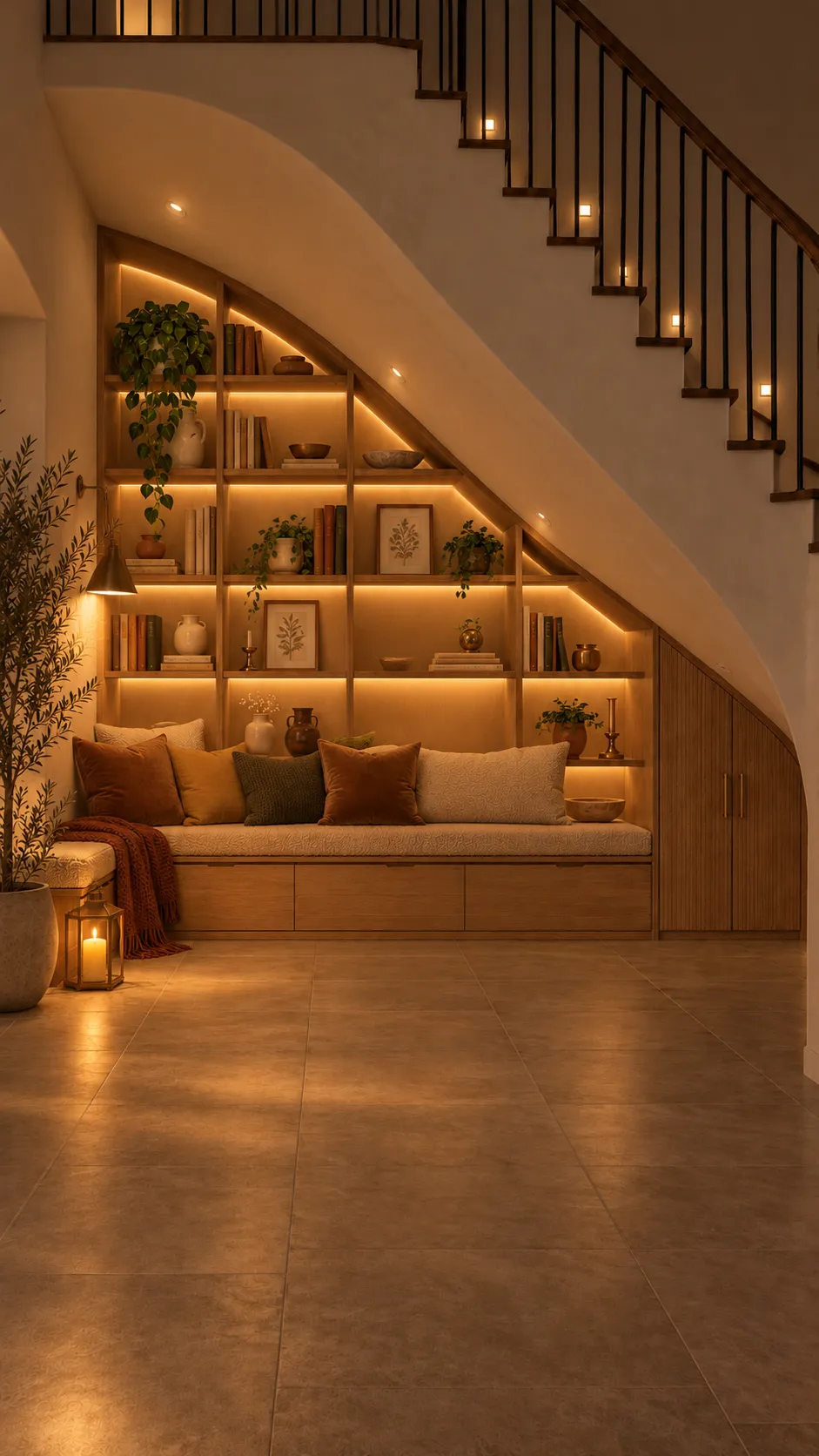
Under a curved staircase the ceiling does not come down in a straight line but describes an arc…
 Staircase
Lujo Cálido
The slatted plane fills the whole triangle the staircase leaves, and along the top edge, right…
 Staircase
Natural Familiar
The dog's bed sits inside an arch cut into the staircase front, not against it. That difference…
 Tu Casa