✨Interior images are AI-generated. Items shown are similar to those in the video.
Mediterráneo Nocturno
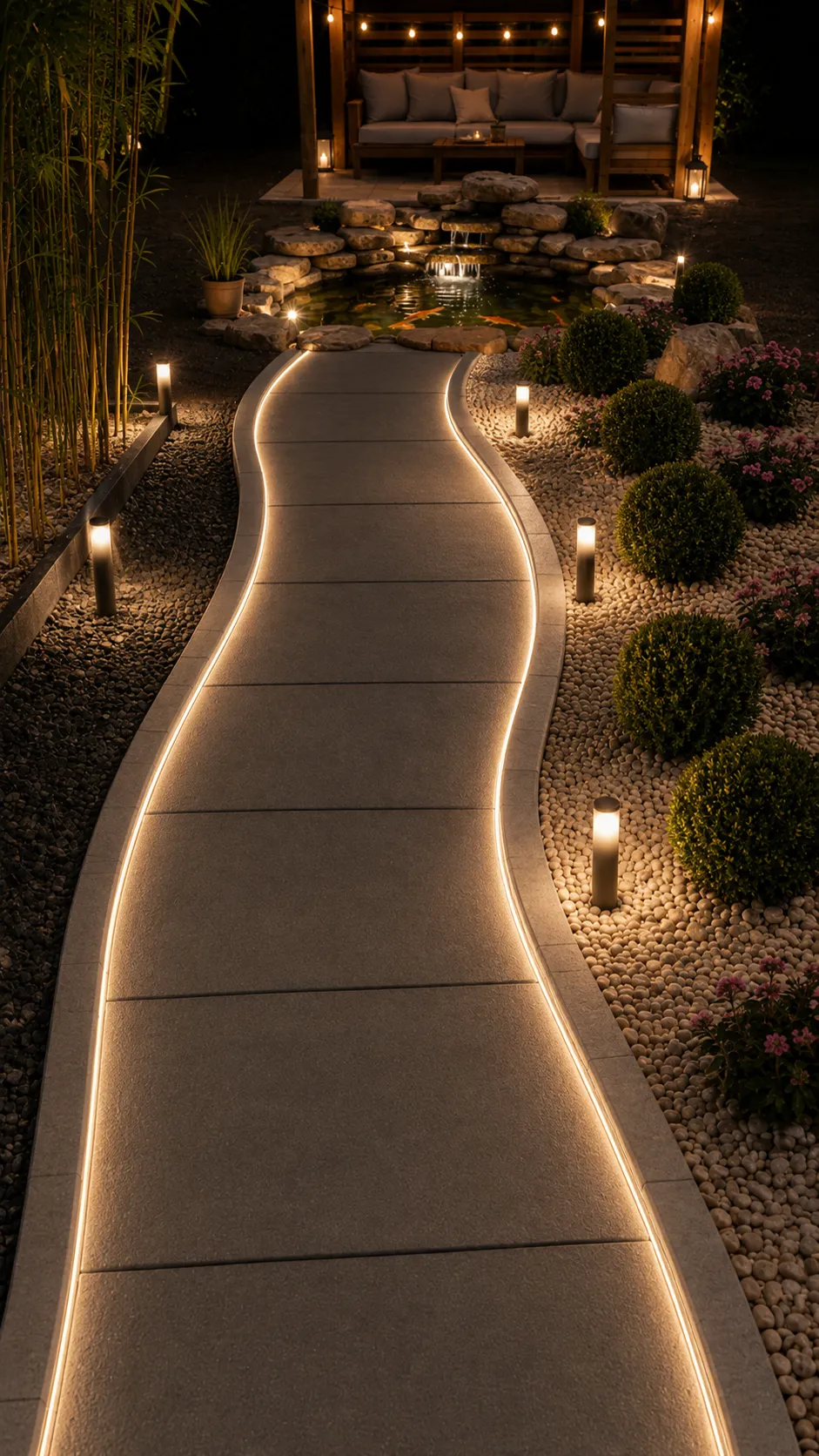
Corridor garden with a grass-jointed path and a pergola at the end
This garden is a corridor between two walls and it's resolved as a route: everything is arranged along one axis ending at two hanging chairs under a pergola. Two decisions make it work. The planting beds are raised on both sides, so you gain planting without taking width from the path. And the path carries living grass joints between the slabs, which is what stops a corridor paved end to end reading as a passageway.
Jardín estrechoJuntas de céspedCamino de losasParterre elevadoPérgolaTrepadoraFaroles de velaApliques de muroSillas colgantesNoche
Design keys
A corridor garden resolved as a route: everything arranged along one axis ending at two seats.
A slab path with living grass joints, set flush so the mower can pass over them.
Raised beds on both sides at seat height, adding planting without taking width from the path.
A row of lanterns at even intervals on the grass, marking the axis from the entrance.
A climber-covered pergola at the far end, with string lights hung beneath the beams.
Wall sconces washing up and down, throwing no light toward whoever walks the path.
Furniture and decor in this design
5
Items shown are similar to those in the video, not necessarily identical.
Turf for path joints
Natural turf rolls to lay between the slabs, better than seed when the strip is narrow: turf covers from day one and there's no risk of seed washing away with the first watering. Choose a wear-tolerant grass mix, because on a path joint you tread right along the edge. Cut it to the exact size before laying, rather than folding it against the slab, or the folded part rots.
An electric line trimmer for the strips a mower can't reach. On a grass-jointed path it's the tool that decides whether the garden is maintained or abandoned: without one, every cut means fifteen minutes on your knees with shears. Choose cordless over corded, because in a long corridor the cable catches on every lantern and every bed corner.
A structure of treated timber beams and posts, made to be covered by a climber. When sizing it, count the weight of the mature plant and not just the structure: a grapevine or wisteria with years on it is heavy and also acts as a sail in wind. Outdoors use pressure-treated timber and posts anchored on metal shoes clear of the ground, because direct contact with soil is what rots a post from the bottom.
Star jasmine, grapevine or wisteria, depending on whether you want a year-round screen or winter sun. Buy one already carrying a couple of long shoots and train it from day one by tying it to the post: a climber that starts spreading at ground level takes years to get up. And plant it into real soil volume rather than a pot at the foot of the post, because on a pergola it has to feed several metres of growth.
Rectangular lanterns in black profile and glass, bought in batches to line a path. What you're buying here is quantity: one or two do nothing, and the effect appears from six or eight spread at even intervals. Use all one model and one height, and plan on battery LED candles: lighting a dozen real candles every evening is something you do twice and then give up.
The grass strip between slabs has to be wide enough to cut. Under a hand's width the mower doesn't fit and it has to be done by hand with shears every fortnight, which is exactly why these paths end up with bare joints.
The slabs sit flush with the grass or a couple of millimetres below, never above. Flush, the mower passes over without touching the blade; standing proud, they have to be trimmed by hand for the garden's whole life.
The beds are raised, and that's why the path keeps its full width. In a corridor garden, planting at ground level would force the route to narrow; by lifting the soil, the planting grows upward and the usable floor isn't touched.
The stiff-leaved species are planted toward the middle of the bed and not at the edge. With a bed wall at seat height, a yucca or agave point at the rim sits exactly where a hand lands when you sit down.
The wall sconces throw light up and down, not toward the path. In a corridor you walk head-on toward them, so a fitting that lights outward dazzles for the whole route; washing the wall, it illuminates without being looked at.
FAQ
How do you build a path with grass joints?
The result is decided by the level and the width of the joint. The slab is bedded on compacted sub-base and left flush with the ground or a couple of millimetres below, never proud, so the mower can pass over without damaging the blade. The joint needs at least ten or fifteen centimetres of width: narrower and it can't be machine-cut, and the grass ends up bare from the slab's shade. And drainage underneath has to be resolved, because a waterlogged joint turns to mud after two days of rain.
What do you gain from a raised bed in a narrow garden?
Walking width, which in a corridor is the only thing in short supply. With the soil lifted onto a low wall, the planting grows upward instead of invading the path, and the paving keeps its full dimension end to end. As a bonus, a low wall at the right height acts as continuous seating without taking any space. The drawback to accept is watering: a raised bed dries out considerably faster than ground-level soil, because it loses water through the sides too, so fit drip irrigation from the start rather than relying on a hose.
Which climber works on a pergola?
It depends what you want in winter. Deciduous ones — grapevine, wisteria — give dense summer shade and let the sun through once the leaves drop, which in Spain is exactly what you want under a pergola you sit under. Evergreens like star jasmine keep the screen year-round but also keep the shade in January. In both cases allow for two things: a mature climber is heavy and the pergola has to be sized for it, and the roots need real soil volume, so it doesn't work planted in a small pot at the foot of a post.
Some links on this page are affiliate links. If you make a purchase through them, we may earn a commission at no extra cost to you.

 Garden
 Garden
 Garden
 Tu Casa