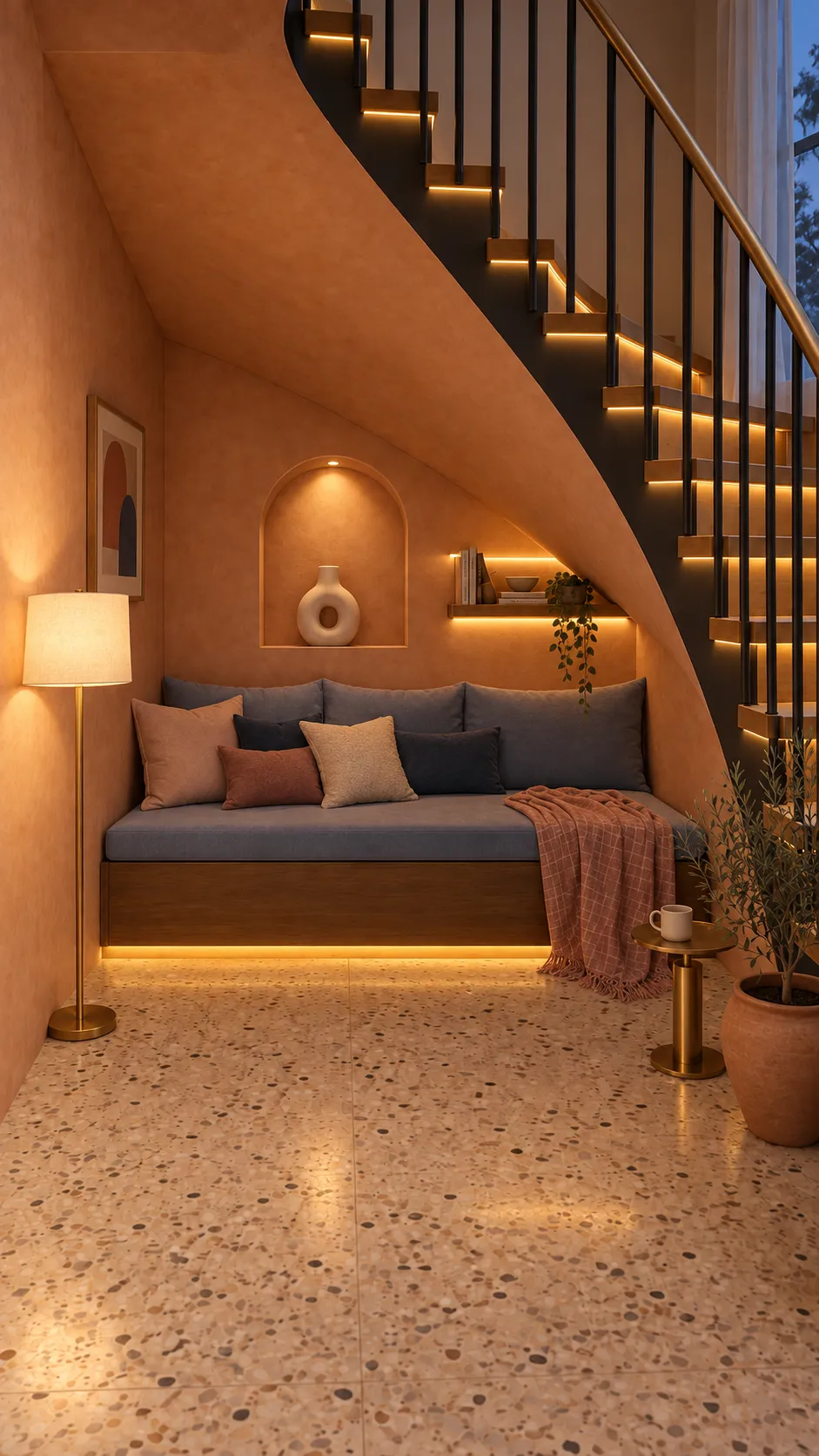
Under a curved stair the logical thing would be a curved bench, and here the opposite has been done: a straight bench, the kind you can buy or order without templates, set into a void that turns. That leaves a wedge of air behind, between the back and the wall, and the point isn't to disguise it but to use it. The lit shelf and the niche are exactly there, in the part the bench no longer reaches.
Items shown are similar to those in the video, not necessarily identical.
Tile with large exposed aggregate, in traditional cement or in porcelain imitating it. The practical difference between the two is porosity: cement wants sealing every few years and porcelain needs nothing, though close up the edge gives away that it's a ceramic piece. Ask to see a complete piece before deciding, because with large grain the colour distribution varies considerably from tile to tile.
See similar on Amazon(paid link)A curved piece ready to fit inside an opening cut in a partition, saving you from bending plasterboard by hand. It comes in several radii and widths, so measure the opening first rather than the other way round. Run the spot's cable before closing the top, because once the arch is fitted there's no access and opening it later means breaking skimmed plaster.
See similar on Amazon(paid link)A straight-lined bench with drawers or a chest under the seat, which is what lets you furnish an irregular void without ordering anything bespoke. If the seat lifts rather than having drawers you don't need clearance in front, which matters in a narrow hallway. Measure the height with the cushion on: many chest benches are around forty centimetres and with a thick cushion rise to fifty, which is already high for comfortable sitting.
See similar on Amazon(paid link)A slim metal stem with a large shade, which in a corner resolved through hidden lighting is the only visible source and the one giving usable light for reading. Check the base diameter before buying: in a narrow passage a thirty-centimetre base becomes an obstacle, and versions with a low, narrow weighted foot get in the way far less. A pale shade spreads better than a dark one, which throws almost everything up and down.
See similar on Amazon(paid link)A continuous coating pigmented throughout, giving a coloured wall with no joints and a texture flat paint can't achieve. Being coloured through its full thickness, a knock doesn't expose grey underneath as it would with painted plaster. Ask for large samples and look at them on the wall at different hours: earth tones change a lot between daylight and a warm bulb, considerably more than an off-white.
See similar on Amazon(paid link)Some links on this page are affiliate links. If you make a purchase through them, we may earn a commission at no extra cost to you.
 Staircase
Mediterráneo Sereno
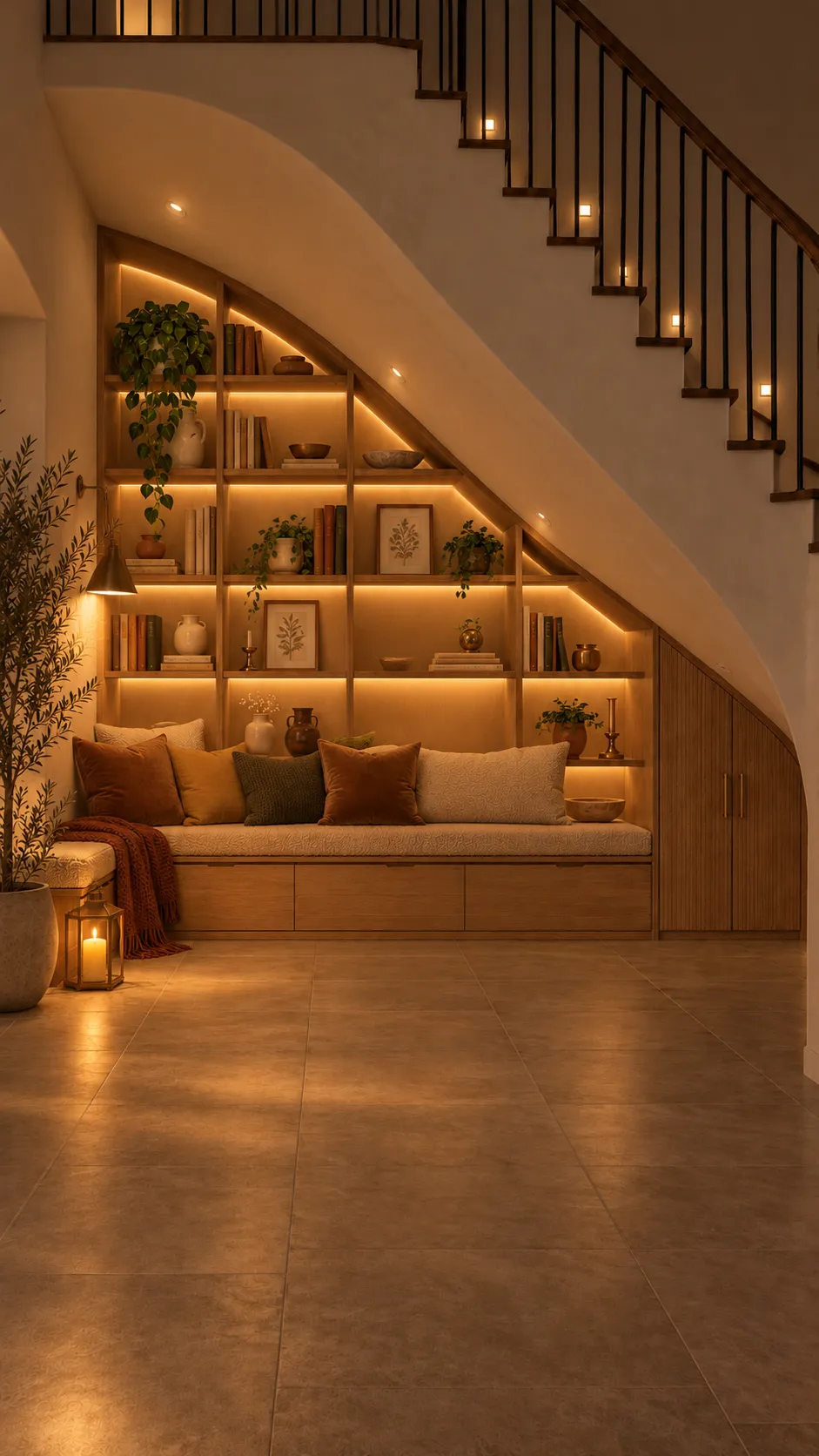
Under a curved staircase the ceiling does not come down in a straight line but describes an arc…
 Staircase
Lujo Cálido
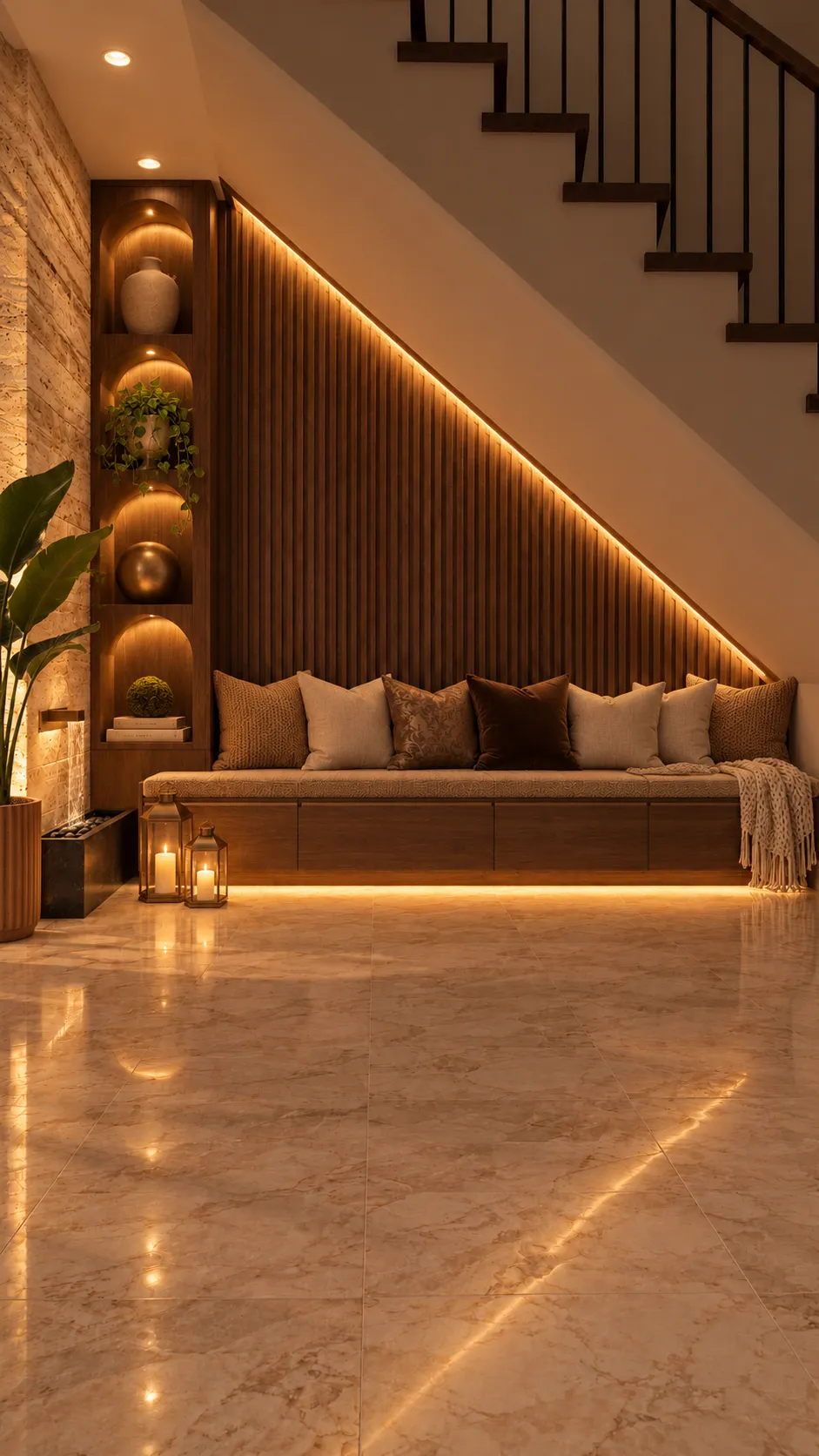
The slatted plane fills the whole triangle the staircase leaves, and along the top edge, right…
 Staircase
Natural Familiar
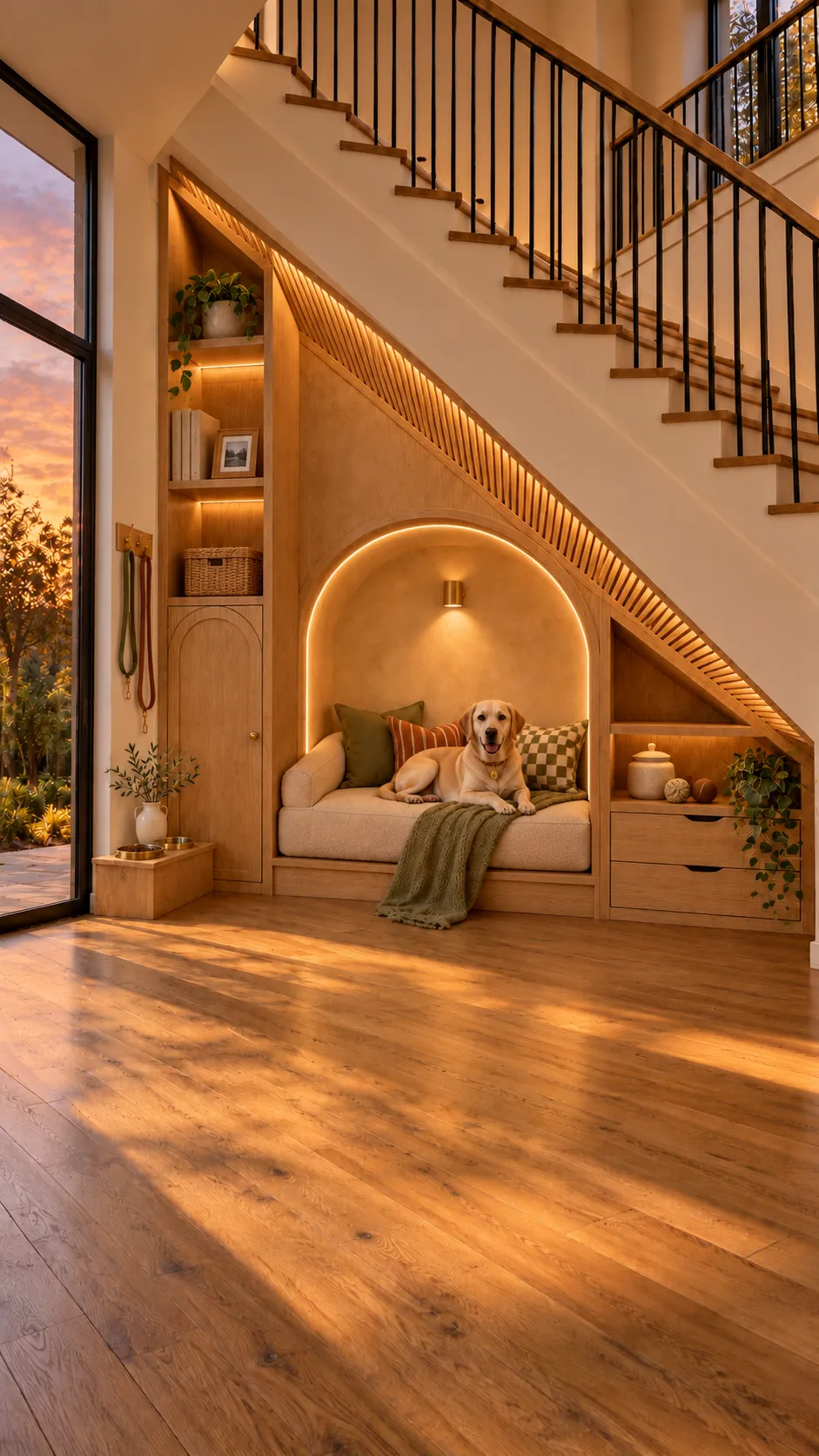
The dog's bed sits inside an arch cut into the staircase front, not against it. That difference…
 Tu Casa