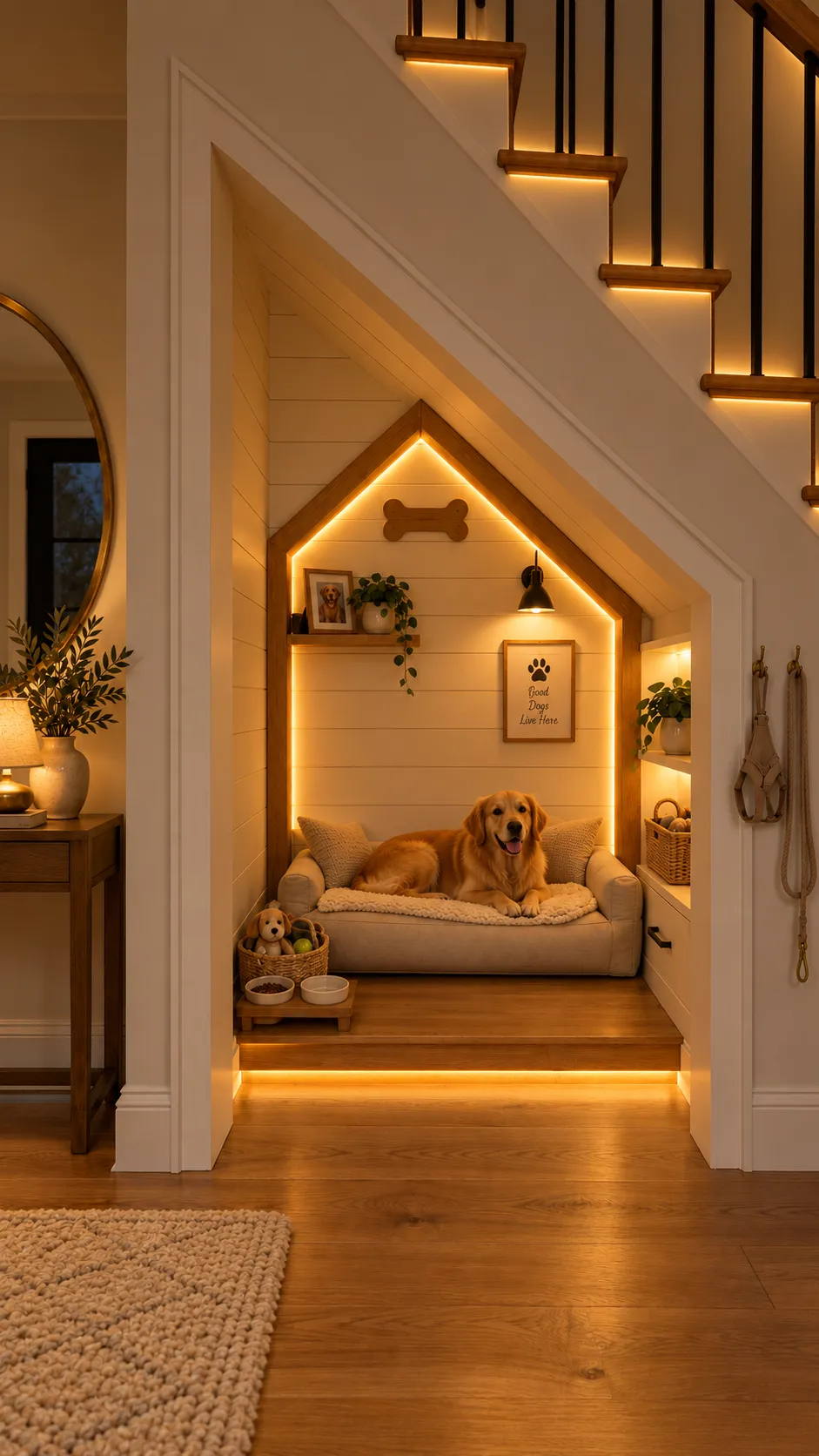
Here the void isn't shared with the dog: it's entirely his. There's a bed to his size, a raised feeding station, a basket for toys and a drawer for leads, all within a house-shaped frame traced by a light strip. What makes this usable rather than merely pretty are two unglamorous decisions: where the bowls go and what gets stored at which height.
Items shown are similar to those in the video, not necessarily identical.
A stand with two recessed bowls, in wood or metal, so a medium or large dog eats without bending its neck. When choosing, look at the height relative to the animal rather than the design: the bowl rim should sit at chest height. Check the bowls lift out and are dishwasher safe, and that the base has non-slip rubber, because a feeder that shifts when pushed ends up tipped over.
See similar on Amazon(paid link)A bed with three raised sides and an open front, the shape sought by dogs that sleep resting their head. The figure that matters is the usable interior rather than the external size: the bolsters eat a fair few centimetres and it's common to buy one too tight. Measure the animal lying stretched out, and look for a version with a fully removable cover, not just a lift-out top cushion.
See similar on Amazon(paid link)An open, low-rimmed basket at floor level, so the animal takes things out and brings them back himself. A lidded box won't get used, and nor will a tall basket if he has to put his whole head in. Choose tightly woven fibre without hanging handles, because loose ends end up chewed; and avoid fine wicker, which splinters when a dog picks it up in his teeth.
See similar on Amazon(paid link)A rail or plate with several hooks at hand height, by the door or in the animal's own corner. It's the piece that stops the lead ending up somewhere different every day, and it wants more hooks than strictly needed so the harness and walk bag fit too. Open hooks are more practical than closed knobs, because a lead with a clip hangs in one movement.
See similar on Amazon(paid link)A quick-drying towel to keep in the corner's drawer, which is where it makes sense: beside the door rather than in the bathroom. Microfibre absorbs considerably more than cotton and dries between one walk and the next, which in winter is the difference between using it and not. Versions with hand pockets hold the paw better without the animal pulling it away.
See similar on Amazon(paid link)Some links on this page are affiliate links. If you make a purchase through them, we may earn a commission at no extra cost to you.
 Staircase
Mediterráneo Sereno
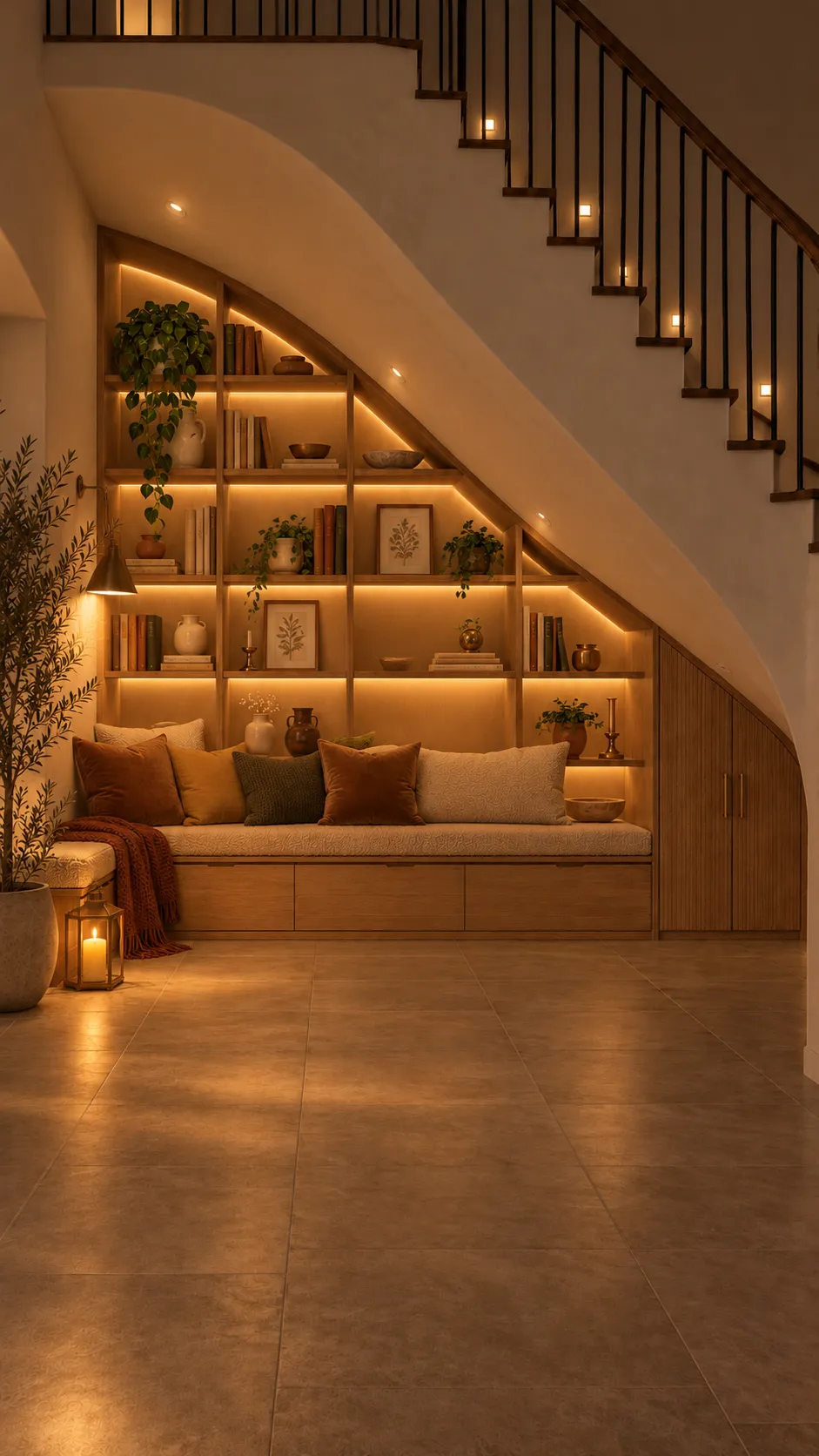
Under a curved staircase the ceiling does not come down in a straight line but describes an arc…
 Staircase
Lujo Cálido
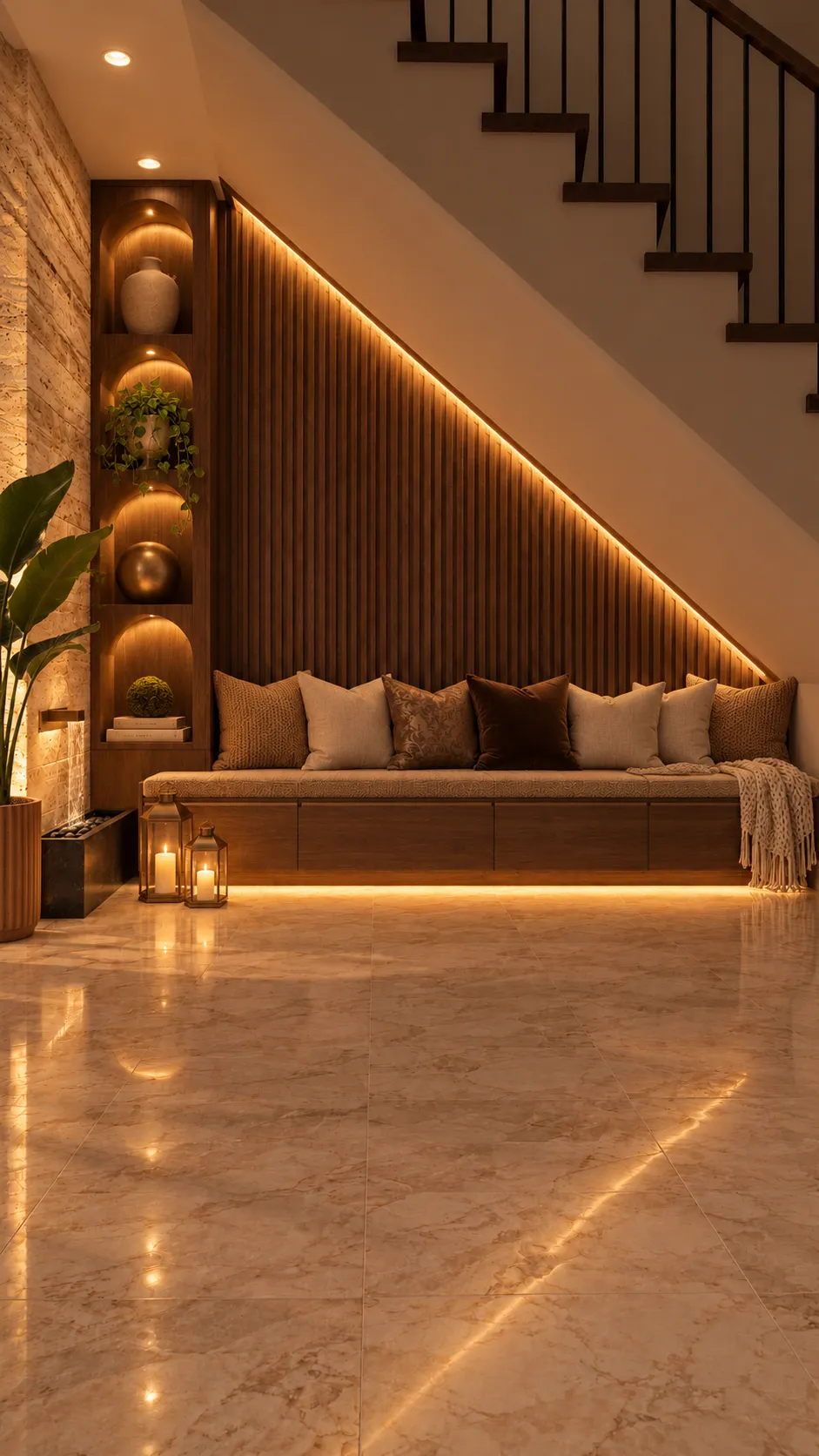
The slatted plane fills the whole triangle the staircase leaves, and along the top edge, right…
 Staircase
Natural Familiar
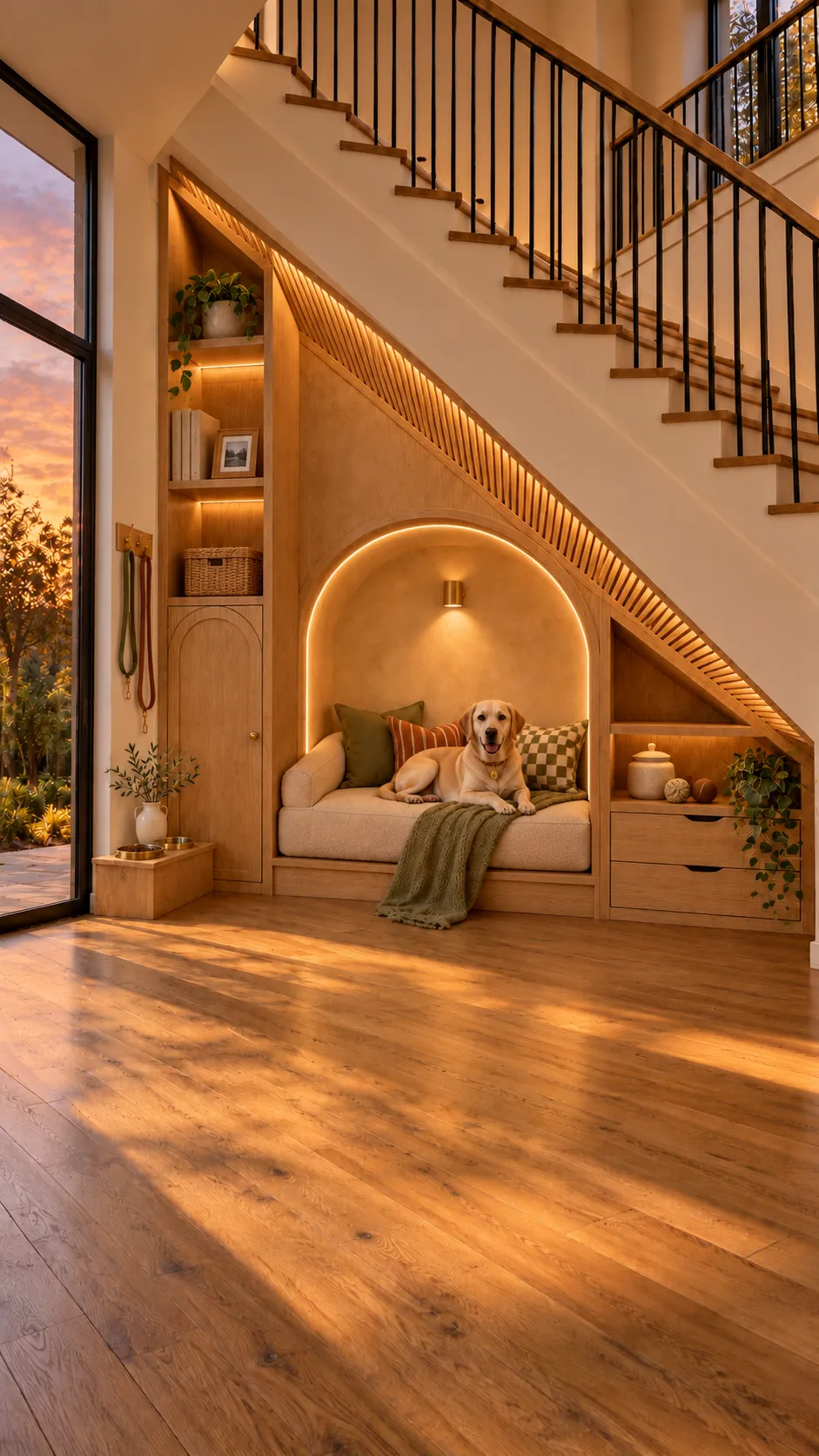
The dog's bed sits inside an arch cut into the staircase front, not against it. That difference…
 Tu Casa