✨Interior images are AI-generated. Items shown are similar to those in the video.
Resort Escultórico
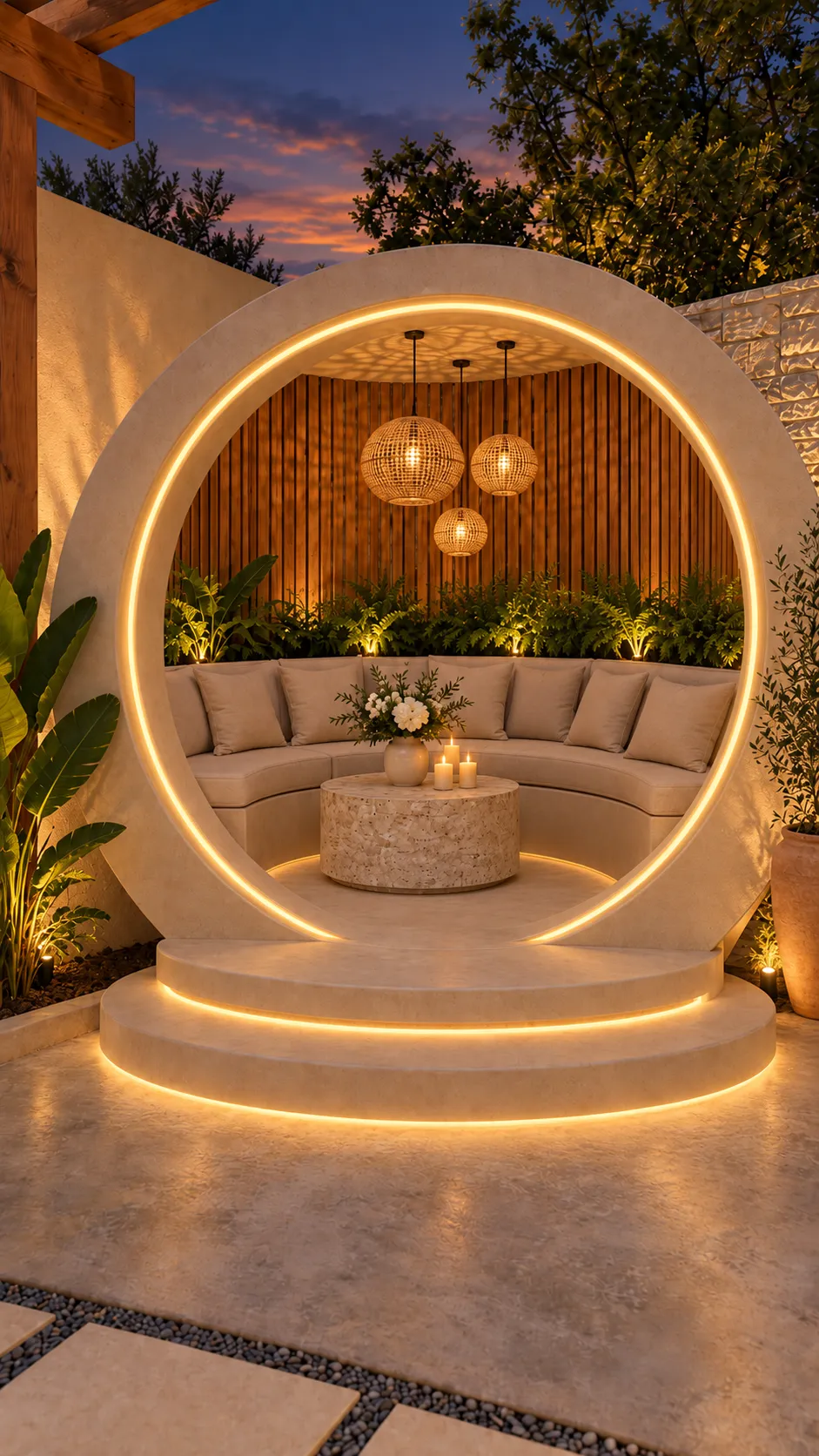
Garden with a lit circular frame and a curved sofa inside
A ring this size isn't decoration set down in the garden, it's a built structure with its own foundations. And it has one rule that nearly always gets broken: what makes it work isn't what goes inside but the void that's left. If the circle fills with furniture to the edges, the form disappears and what you see is a sofa against a round wall; here the seating stops at the lower half and the upper half is deliberately left empty.
Aro de obraEstructura circularPantalla de listonesTarima circularLuz perimetralSofá curvoCimentaciónMortero continuoPatioAtardecer
Design keys
A free-standing built ring resting on two circular steps, with its own foundations below the paving.
A perimeter groove on the ring's inner face holding a light strip, drawing the whole circle with no visible source.
The upper half of the circle left empty: the sofa goes no higher than the line of its backs.
A vertical slat screen behind, free-standing on its own posts, closing the backdrop without being a wall.
Two curved steps lit beneath the nosing, repeating the circumference at floor scale.
A round terrazzo table at the centre, the only material with grain among so much smooth surface.
Furniture and decor in this design
5
Items shown are similar to those in the video, not necessarily identical.
Continuous exterior render coating
Acrylic or lime render for finishing a built piece without joints, which is what lets a ring or a curved wall read as a single surface. On a round form it's practically the only option, because any material in pieces means cutting and leaves a pattern of joints. Ask for the flexible version if the piece is free-standing: a structure that moves with the sun cracks a rigid render at its narrowest point.
A panel of vertical slats that doesn't screw to a wall but stands on its own posts, closing a backdrop in the middle of the garden. What to check isn't the panel but the posts and the fixing system: use a metal shoe bolted to a concrete pad rather than the post buried directly, because timber in contact with soil rots at the foot within a few years even if the rest is perfect.
A concrete block with the metal shoe already cast in, for anchoring screen and pergola posts without formwork. It saves a lot of time against casting the pad in situ, but check two figures: the recommended depth for the post height, and whether the shoe is adjustable, because on ground that isn't perfectly level that's what lets you get every post plumb.
A low table in terrazzo or exposed-aggregate concrete, bringing grain to a set of smooth surfaces and standing outdoors without annual treatment. The drawback is weight: an eighty-centimetre solid terrazzo top isn't moved single-handed, so decide its place before carrying it into the garden. Outdoor grades need no sealing, but an indoor version used outside picks up leaf and limescale staining quickly.
A thick tile, usually twenty millimetres, intended to be laid spaced with the gap filled with pebble or grass rather than mortar. It lets water drain between pieces and avoids having to fall the whole surface. It needs a compacted, well-levelled base, because without mortar each piece bears on its own and one badly bedded is noticeable underfoot.
Decide the diameter by the head height, not by the photo. If the ring sits on a two-step platform, that height comes off the opening: with a two-and-a-half-metre circle and a thirty-centimetre platform you're left with just over two metres of clearance, which is the minimum for walking through without ducking.
Build the ring hollow rather than solid. A steel frame clad in mesh and rendered weighs a fraction of what it would in concrete, and that hugely reduces the foundations you have to bury underneath.
A tall, narrow ring takes a lot of crosswind. Resting it on the paving doesn't solve that: it needs foundation pads buried under each springing, sized by someone who has seen the ground, because overturning is the only real risk with a piece like this.
Allow for the light groove while building rather than afterwards. The strip sits in a recess on the inner face, and cutting that groove into a cured render means breaking out and re-rendering the whole ring.
The slat screen behind doesn't anchor to the ring. They're two independent structures that move differently, so the screen gets its own posts set into the ground; tying it to the ring eventually opens a crack in the render right at the connection.
FAQ
What should you know before building a structural ring in the garden?
Three things, and the design is the last of them. First is usable diameter: what matters isn't the circle but the opening left to walk through, and if the ring springs from a platform that height has to come off. Below two metres of clear height you end up ducking every time. Second is how it's built: solid concrete weighs so much that the foundations become the bulk of the job, whereas a steel frame clad in mesh and rendered gives the same visual result at a fraction of the weight. And third is wind. A tall, narrow piece with a large surface works like a sail, so resting it isn't enough: it needs foundation pads under both springings, and those want sizing by someone who knows the ground and the location.
How do you fix a free-standing slat screen?
On its own buried posts, never by tying it to another structure. A slat screen isn't a wall but it is a large surface, and although some air passes between slats it still takes considerable wind load. The posts set into concrete pads, with the buried portion around a third of the visible height, and the post is better not bearing directly on the concrete but on a metal shoe holding it clear of the ground, because the buried foot is where any timber rots first. One detail that gets forgotten: don't fix it to an adjacent built element, like a ring or a garden wall. The two move differently with temperature and humidity, and the connection point eventually cracks the render.
How do you furnish the inside of a circular structure?
By leaving the upper half empty, which is the opposite of what instinct asks for. A circular form reads through its perimeter, and if it fills with height — furniture, shelves, plants — the eye stops seeing the circle and starts seeing a cluttered backdrop with a round edge. The practical rule is that nothing rises above the line of the seat backs: above that height, air. The same goes for depth: keep the furniture within the ring's thickness rather than projecting in front, because the moment a sofa arm crosses the circle's plane the piece stops reading as a frame. And the table is better low and round, the one thing that accompanies the geometry instead of fighting it.
Some links on this page are affiliate links. If you make a purchase through them, we may earn a commission at no extra cost to you.
 Garden
 Garden
 Garden
 Tu Casa