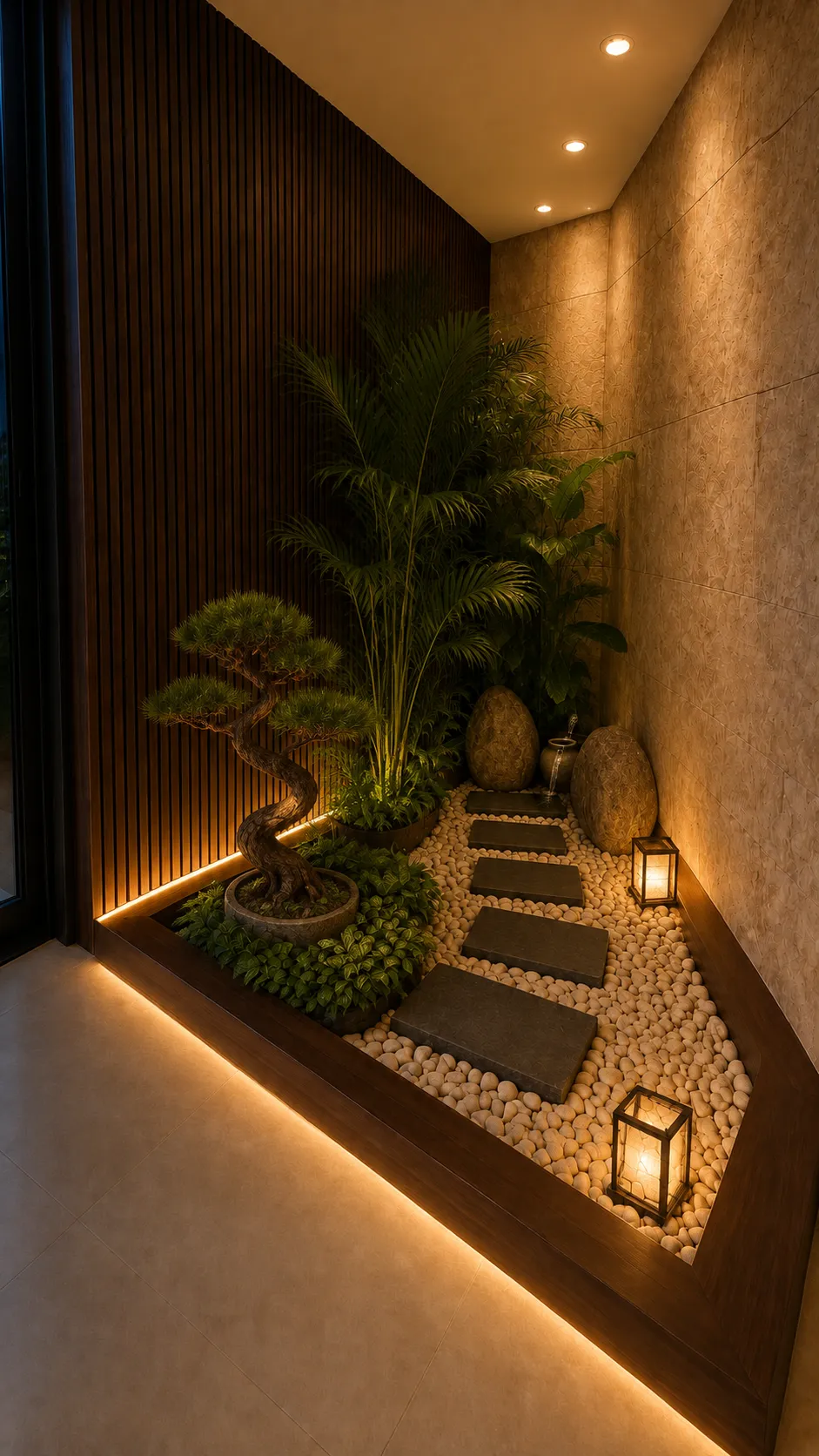
This corner is barely a metre and a half across and nobody walks into it: it's looked at, and always from the same place. That's why everything is composed for that single viewpoint — the planting stepped from back to front, the pine leaning out into the empty side, the slabs marking a direction even though no one treads on them. The bed sits raised on a timber edge with a light strip beneath, between one wall of dark slats and another of pale stone.
Items shown are similar to those in the video, not necessarily identical.
Ficus retusa or ginseng, the bonsai species that genuinely survives indoors. When buying, look at the trunk and branching before the size: a ginseng with a swollen root is cheap but doesn't read as a tree, while a trained retusa costs more and improves with the years. Put it in the brightest spot available and water by pot weight rather than by calendar.
See similar on Amazon(paid link)A set with pruning shears, a concave cutter, a rake and wire. The piece that matters is the concave cutter: it leaves a sunken cut that heals invisibly, while ordinary shears leave a stub that shows forever. With a single tree you don't need the twenty-piece kit; shears, a concave cutter and wire in two gauges cover everything you'll actually do.
See similar on Amazon(paid link)A probe you push into the pot that reads dry, moist or waterlogged. It's the cheapest thing you can buy for an indoor bed and it prevents the error that kills most houseplants, which is watering out of habit. Measure in the middle of the pot at half depth: near the surface it nearly always reads dry even when the bottom is soaked.
See similar on Amazon(paid link)A textured stone or resin piece, the kind set whole rather than buried. In a composition like this a boulder acts as mass and as a pause between plants, so one large piece beats several medium ones. Resin weighs little, which on a bed over a slab is an advantage, but inspect it closely: the ones imitating coarse pores convince from a distance and give themselves away at a metre.
See similar on Amazon(paid link)White or cream river pebble in a large grade, the kind laid by hand rather than shovelled. Indoors, a large grade pays off far more than fine grit: it doesn't catch in shoe soles, doesn't escape over the bed edge, and can be lifted out, rinsed and returned when it gets dusty. Rinse it before laying, because it arrives with a fine dust that marks the floor at the first watering.
See similar on Amazon(paid link)Oak treated to darken right through rather than only at the surface, so a knock or a cut doesn’t expose pale wood. That’s the difference from a stain: with smoking the colour goes all the way in. It works well lit from below, which is when the grain lifts; under direct frontal light, by contrast, smoked oak reads almost like a flat panel and all the relief is lost.
See similar on Amazon(paid link)Some links on this page are affiliate links. If you make a purchase through them, we may earn a commission at no extra cost to you.
 Living room
Minimalista Oscuro
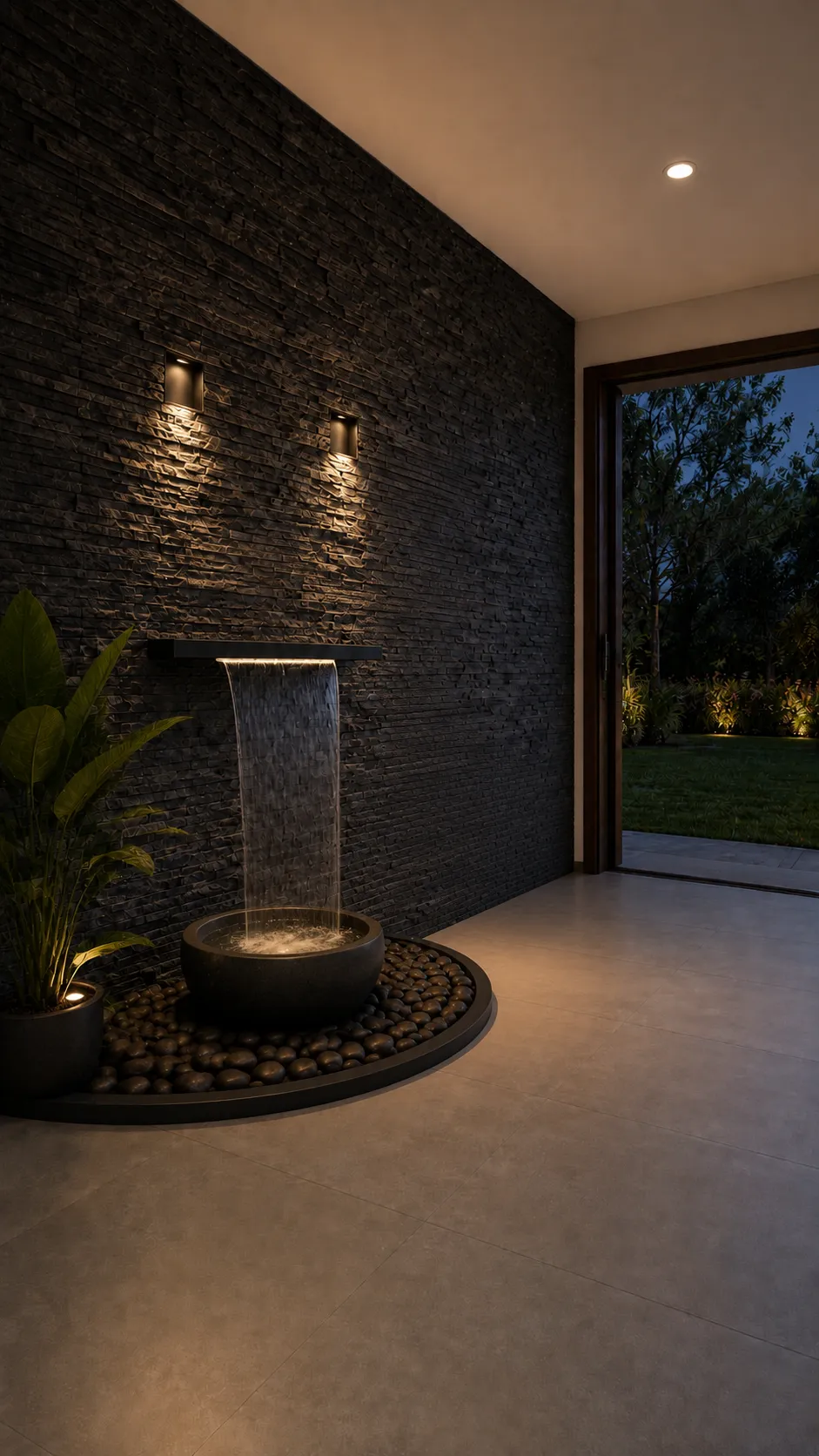
This waterfall has no built basin and no light of its own, and both absences are decisions. The…
 Living room
Cálido Contemporáneo
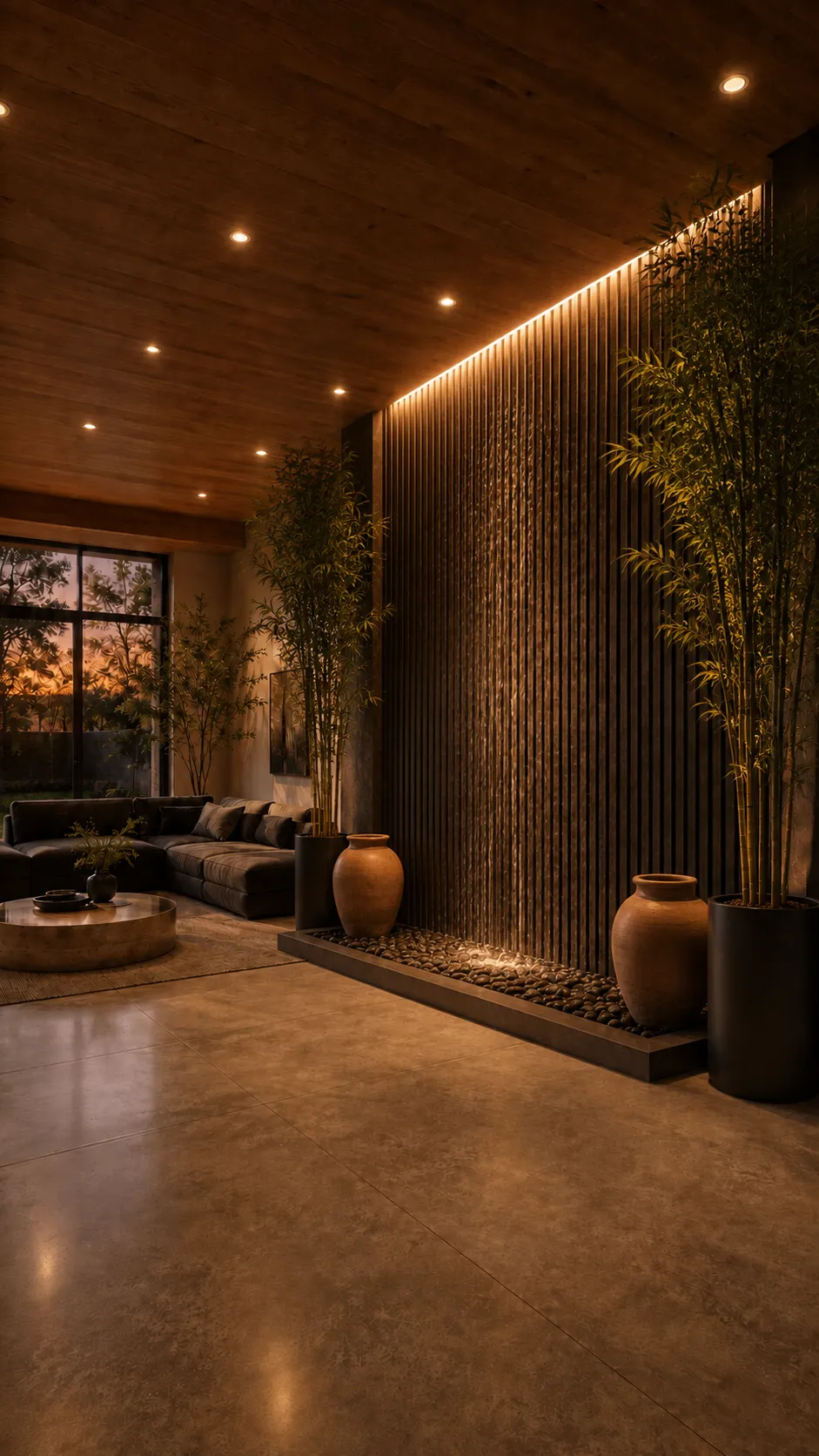
This water curtain isn't set against a wall: it is the wall. It separates the living room from…
 Living room
Moderno Nórdico
A city-view living room where dark wood slat panels flank the TV, illuminated by black cylindrical…
 Tu Casa