✨Interior images are AI-generated. Items shown are similar to those in the video.
Zen Nocturno
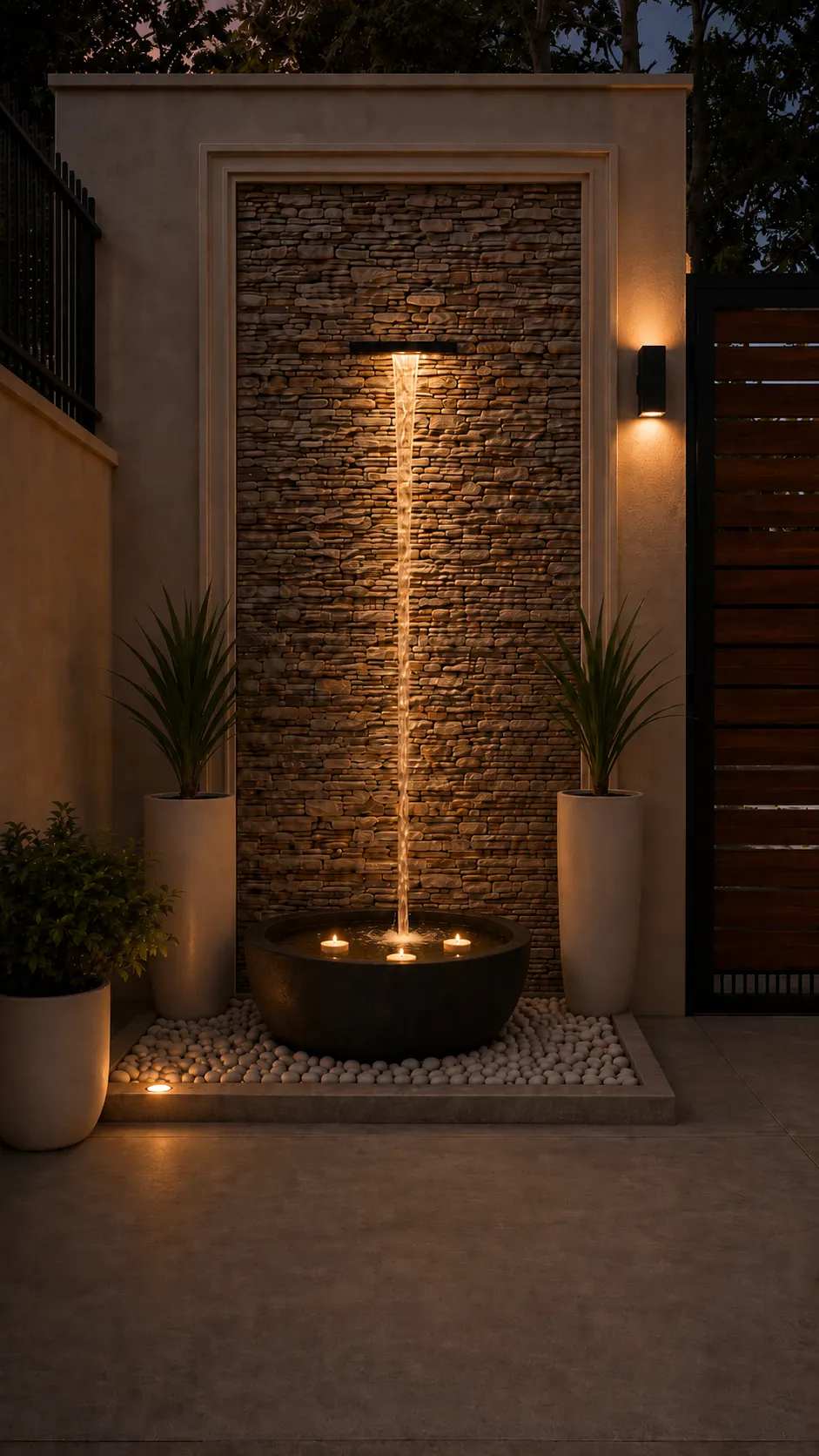
Narrow-jet fountain on stacked stone with a bowl and candles
This fountain doesn't pour a wide sheet but a single narrow jet, and that changes all the sums. A fall of nearly three metres in a fine thread arrives far more dispersed than it leaves, drifts in the wind and sounds different: sharper and more present than the steady murmur of a sheet of water. That's why the bowl below is wide and why there's a ring of pebble around it, catching everything that misses.
Chorro finoPiedra apiladaMoldura de remateCuenco de fuenteVelas flotantesCanto rodadoCaída largaAplique de doble emisiónPatioAtardecer
Design keys
A single narrow jet poured from the top of the panel, rather than a sheet covering the full width.
A stacked stone panel framed by a moulding that hides the cut edges on all four sides.
A round bowl resting on the ground, considerably wider than the jet to absorb the fall's drift.
A ring of white pebble around the bowl, within a square marked by its own kerb.
Candles floating on the water, placed on the side opposite where the jet lands.
An up-down wall light on the side wall, washing both ways and leaving the stone as the only face lit head on.
Furniture and decor in this design
5
Items shown are similar to those in the video, not necessarily identical.
Floating candles for a fountain
Wide-based candles designed to sit on the water's surface. On a recirculating fountain the LED version beats wax: it sheds no paraffin into the water, doesn't go out from spray and stays lit all evening. If you choose wax, remove them before they burn down completely, because the remains end up at the pump intake and are hard to get out once inside the circuit.
A narrow outlet nozzle, in steel or brass, for a single-thread fall rather than a sheet. What to check is the recommended flow: too little and the thread breaks up as it falls, too much and it splashes outside the basin, so fit it with a regulating valve on the feed so it can be adjusted once installed. On falls over two metres it's worth testing before closing up the wall.
A housing with a sponge or basket fitted at the intake, catching leaves, wax and grit before they reach the impeller. On an outdoor fountain it's what prevents the commonest failure, a pump seized by something nobody saw go in. Choose a model that opens without tools and with replacement sponges available, because it needs rinsing every few weeks and if it's awkward it doesn't get done.
A fitting throwing light up and down through two openings in the body, drawing two cones on the wall face. It works well on a smooth wall and badly on textured stone, because grazing light picks out every course and makes the wall the most eye-catching thing there. Check the IP rating and the beam angles: very tight ones leave two sharp triangles while wider ones wash the wall more continuously.
A plant with stiff leaves in a rosette, giving verticality in a tall pot while needing almost nothing. It takes direct sun, drought and neglect, which is what you want from a plant beside a fountain where watering isn't appealing. The leaves end in a hard point, so don't place it in a narrow passage at face height; and if the pot drains badly, that's one of the few things that kills it.
With a long fall, size the bowl by the height rather than the flow rate. A jet that leaves clean at the top arrives open and displaced, so allow a diameter of at least a third of the fall height for the water to land inside even with some wind.
If the jet breaks up before arriving, raise the flow or shorten the fall, but reckon with the noise. A fine thread falling three metres sounds sharper and carries further than a wide sheet, which produces a more even murmur and blends into the background sooner.
Candles go at the end away from the fall. Moving water pushes them, and under the jet they go out within minutes; with the basin filled to the brim they drift more still, so keep the level a couple of fingers below the rim.
The perimeter moulding isn't only decorative: it covers the stone panel's edges, which is where you see each piece's cut and the mortar behind. Without that finish you need the manufacturer's own corner pieces or the panel set back into the wall.
Keep the wall light on the side wall rather than over the stone. An up-down light placed above the panel would pick out every course with its shadow and compete with the jet; from the side, the stone takes grazing light at one end only and the water stays the brightest thing there.
FAQ
What changes between a narrow jet and a wide sheet on a wall fountain?
Almost everything except how it photographs. A narrow jet needs far less flow, so the pump is smaller and consumption lower, but it has two drawbacks the sheet doesn't. The first is that it doesn't cope with long falls: the thread opens up through friction with the air and beyond two metres it arrives as dispersed water rather than a jet, which forces you to raise the flow to keep it defined. The second is wind, which pushes a fine thread several centimetres with very little breeze, something a wide sheet barely notices. As for sound, the jet reads sharper and more pointed, while the sheet gives a continuous murmur that blends into the background sooner and disturbs less if the fountain is near a seating area.
Can you float candles in a fountain?
You can, with three precautions. The first is the current: moving water drags the candles towards the landing point and there they go out at once, so place them at the opposite side and, if the basin is small, reduce the flow while they're lit. The second is wax, because a real floating candle sheds melted wax into the water, that wax floats and ends up at the pump's intake: on a recirculating fountain you want a prefilter and to remove spent candles rather than leaving them to burn out. The third is obvious but gets forgotten: outdoors, between air movement and spray, a real flame doesn't last. Floating LED candles solve all three and at night, from a distance, they're far harder to tell apart than you'd expect.
How do you finish the edges of a stacked stone panel?
It's the part that most gives this kind of cladding away and it's almost never costed. Stacked stone pieces are panels with slips bonded to a backing, so cutting them exposes each slip's edge and the backing's mortar, and that irregular border shows from a distance. There are three solutions. The first is buying the corner pieces the same supplier makes, which carry the stone folded round the corner and resolve the junction. The second is this fountain's: framing the panel with a moulding or surround covering all four edges, which also turns the face into a piece with clear limits rather than endless cladding. And the third is setting the panel back into a recess, letting the wall itself cover the edges.
Some links on this page are affiliate links. If you make a purchase through them, we may earn a commission at no extra cost to you.
 Garden
 Garden
 Garden
 Tu Casa