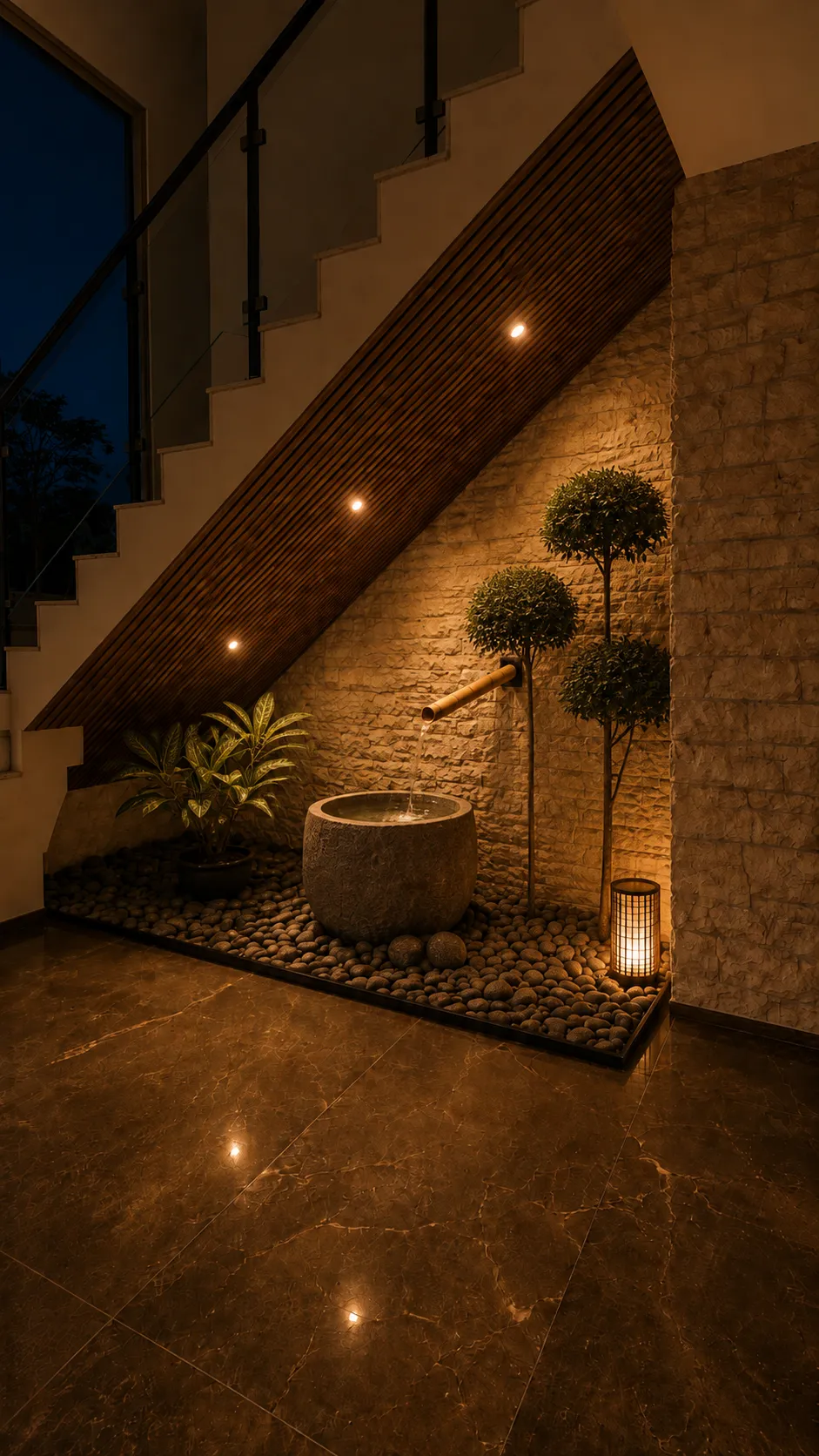
The piece in the middle has its own name: it's a tsukubai, the low stone basin placed in Japanese gardens for washing your hands before entering the tea house, and low enough that you have to crouch. The water arrives through a bamboo spout as a thin thread, not a jet. Around it, dark pebble edged in black steel against the polished floor, and above, the underside of the staircase clad in slats that follow the slope and carry the downlights within.
Items shown are similar to those in the video, not necessarily identical.
A set comprising a stone basin and a spout, with a submersible pump recirculating the basin's own water. Check the weight before buying: a carved granite basin sixty centimetres across easily exceeds a hundred kilos and, on a polished floor, needs two people and a felt pad. In natural stone the inside must be sealed, or the vessel weeps and leaves a damp ring around the base.
See similar on Amazon(paid link)A drilled bamboo cane with its bracket, the kind you swap when the previous one splits. Buy the spare at the same time as the fountain and keep it: diameters vary between makers, and finding one that fits the original bracket two years later is harder than it sounds. Before fitting, two coats of oil inside and out extend its life considerably.
See similar on Amazon(paid link)A topiary with a spherical crown on a bare stem, in a live or artificial version. The live one wants plenty of light and clipping every few weeks to hold its shape, so in an under-stair void it rarely works out; a decent artificial holds up at this distance and needs nothing. If you go live, a bay or a trained ficus are the most manageable indoors.
See similar on Amazon(paid link)A bamboo-framed lantern with a translucent diffuser, the floor-standing kind. It diffuses in all directions and lights nothing in particular, which is exactly its job here: marking a point at floor level without competing with the spots above. Choose the LED and cable version over the candle one, because at that height and beside water a real flame blows out in any draught.
See similar on Amazon(paid link)Codiaeum variegatum, the red, yellow and green leaved plant supplying the only colour in this corner. In Spain it lives only indoors or in very sheltered southern spots, because below around thirteen degrees it drops its leaves. It wants plenty of indirect light and humidity: in a heated interior mist it, or keep it near the fountain where the air stays damper.
See similar on Amazon(paid link)High-grab cartridge adhesive, the route when you can’t or don’t want to drill, for instance on the sloping underside of a staircase where the partition is thin. Apply it in vertical beads rather than dabs, so the panel can expand. One condition can’t be skipped: the wall has to be sound and dust-free, because on loose textured paint the adhesive pulls off the coating rather than gripping the wall.
See similar on Amazon(paid link)Some links on this page are affiliate links. If you make a purchase through them, we may earn a commission at no extra cost to you.
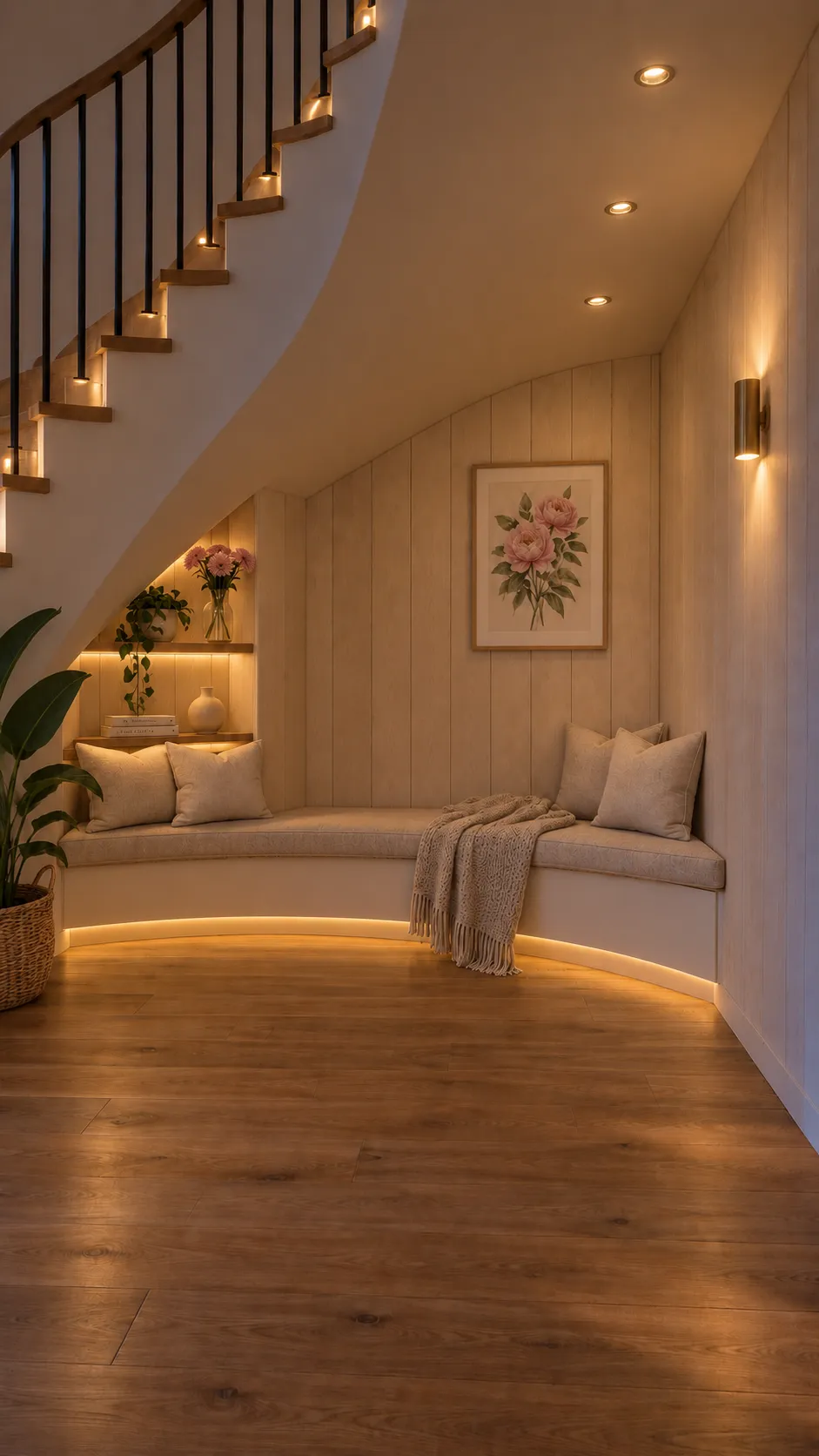 Staircase
Nórdico Suave
The void under a straight stair is a triangular prism and it's resolved with measurements; under a…
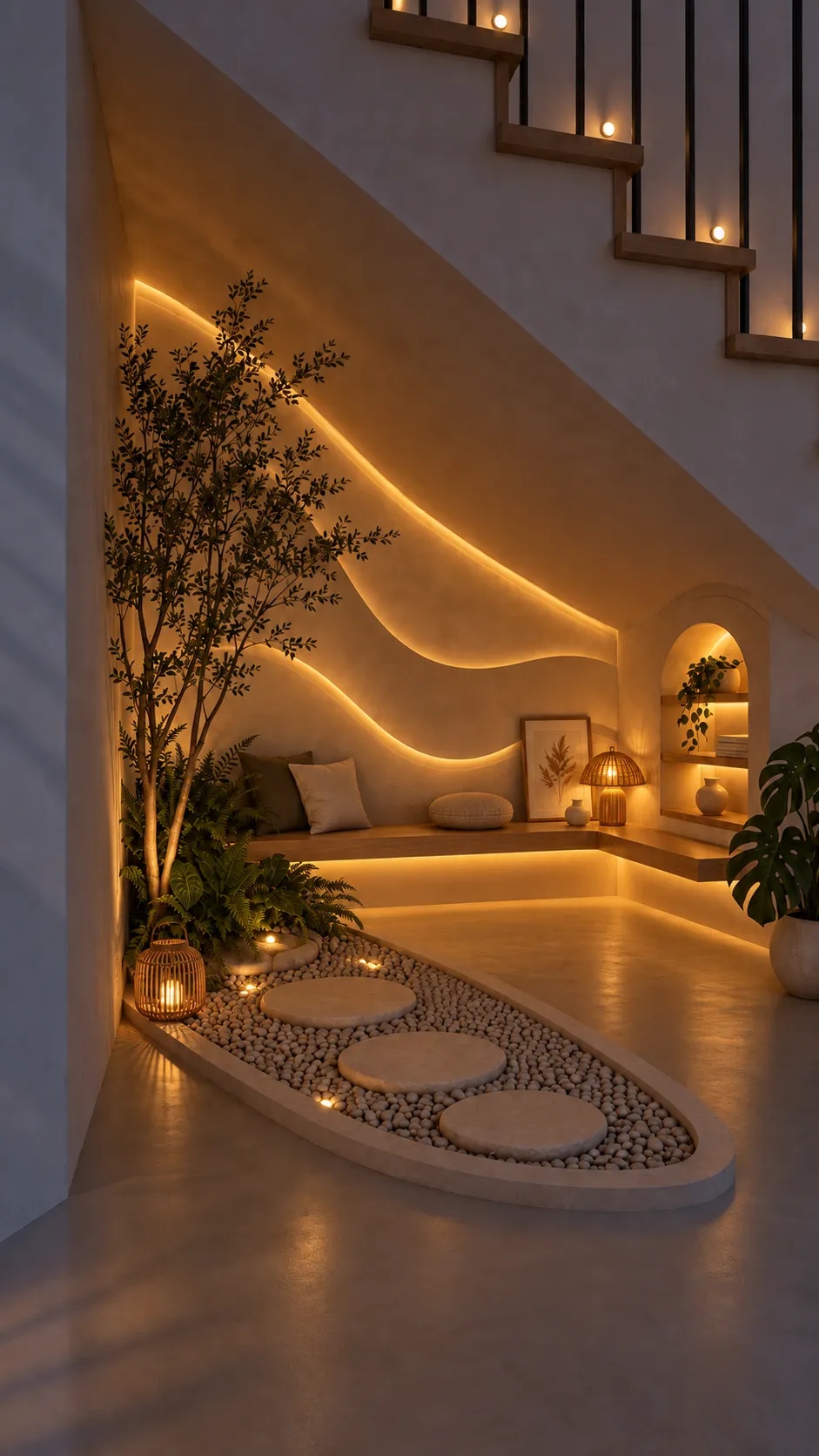 Staircase
Orgánico Sereno
Bringing gravel indoors sounds like an indulgence until you see it resolved as it is here: an…
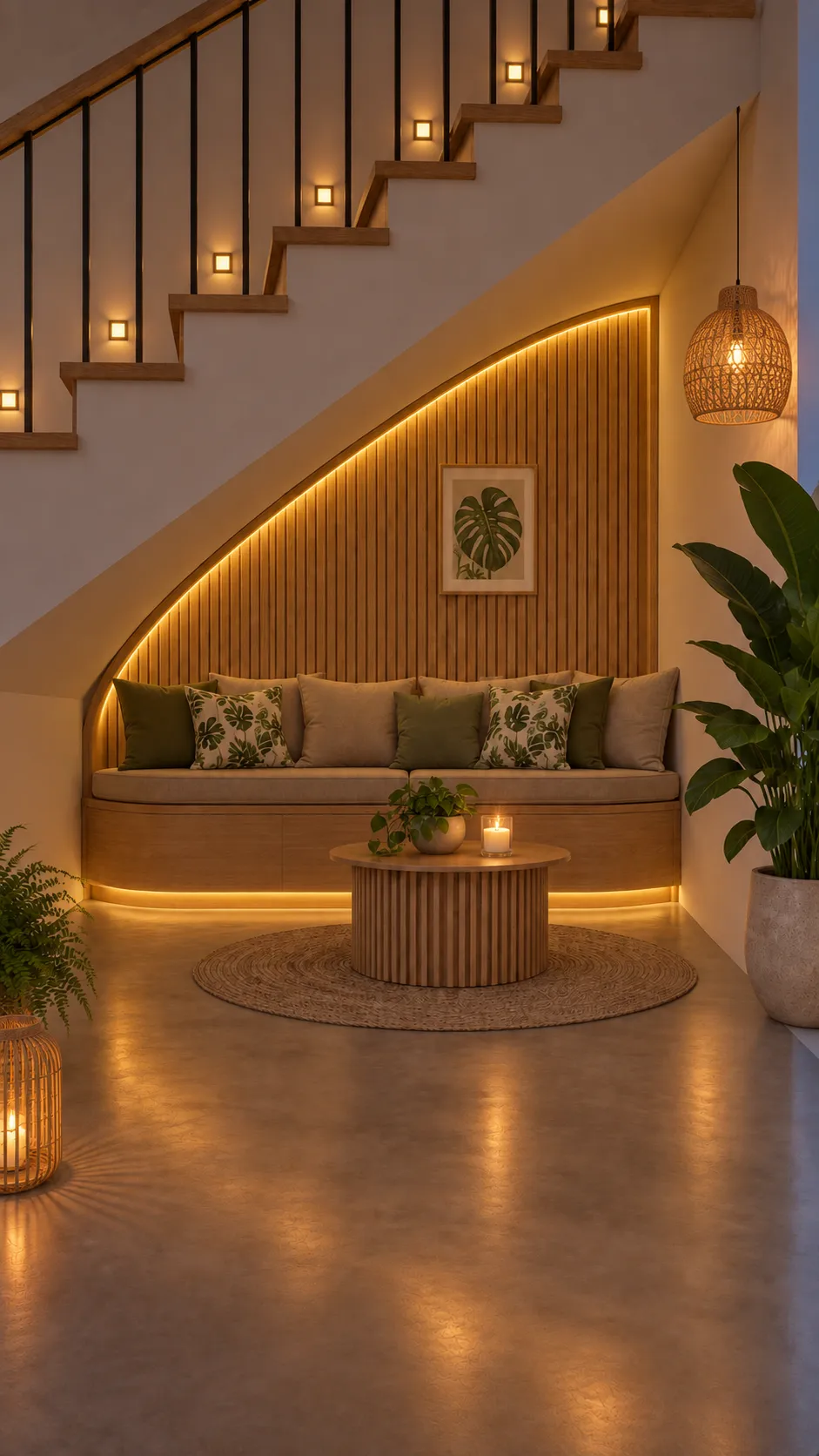 Staircase
Boho Chic
The space under the stairs stops being a leftover triangle and becomes the cosiest corner in the…
 Tu Casa