✨Interior images are AI-generated. Items shown are similar to those in the video.
Orgánico Cálido
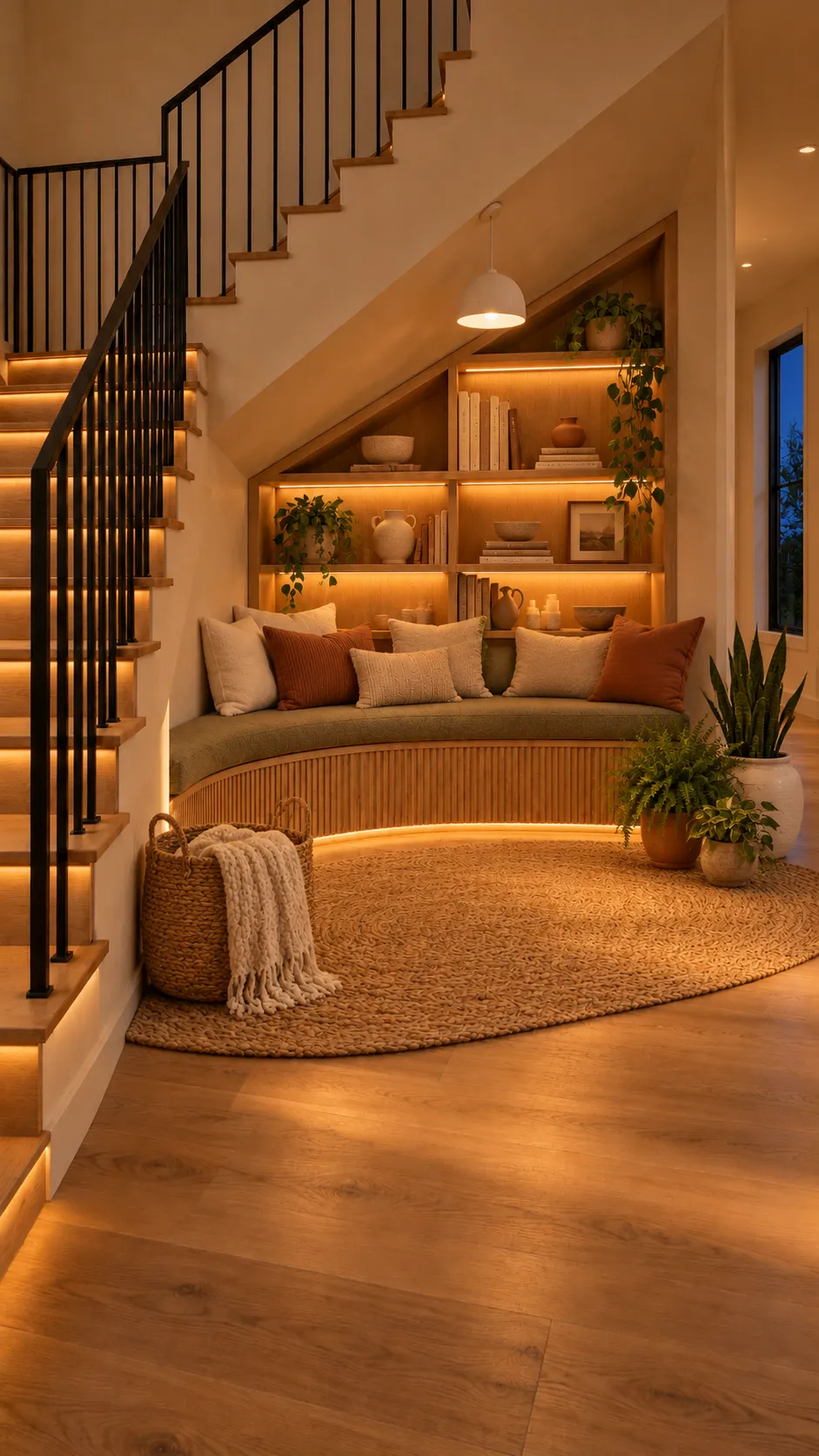
Under-stair bench with a curved front to free up the walkway
The void is straight and so is the staircase, so the bench could have been a rectangular box. The front was curved on purpose, and not for looks: a straight bench leaves two sharp corners right on the line you walk to get into the house, and in a narrow hall those two corners are what you bark your leg on for years. The curve eats a little seat at the ends and gives the whole walkway back.
A built bench with a curved front in plan, with no sharp corner towards the circulation zone.
A fine-slat fluted front following the curve, built from flexible panel rather than straight slats.
An olive green upholstered seat, its padding cut to the same curve as the base.
Shelves built into the triangular void, their depth reducing as the slope comes down.
A hidden LED strip under each shelf and in the bench plinth, the corner's only light besides the pendant.
A round jute rug echoing the bench's curve and marking the corner's edge on a continuous floor.
Furniture and decor in this design
5
Items shown are similar to those in the video, not necessarily identical.
Flexible slat panel on a roll
Fine slats on a textile or mesh backing, supplied rolled and adapting to a curve because each slat turns relative to its neighbour. It is the practical way to build a curved fluted front without a workshop. Always check the minimum radius the maker states and compare it to your bench's curve: below that radius the slats ride over each other and the face opens up.
A seat made up with foam cut to the bench's actual plan, the only thing that fits when the front is not straight. Send a paper template of the outline rather than dimensions: a curve described in numbers always comes back different. Ask for high-density foam of five or six centimetres, because thinner sinks at the front edge and the curve deforms within months.
A profile with an opal diffuser to recess or stick under a shelf's front edge, which is what turns an LED strip into a line of light instead of a row of dots. Ask for the matt diffuser rather than the clear one, because from the sofa you see the LEDs one by one. And cut it two centimetres shorter than the shelf at each end so the cap does not show.
A round or oval rug, the one that goes with a curved-front bench and that defines a corner on continuous boarded flooring. Measure the diameter including the walkway in front of the bench: it has to reach where your feet land when you sit and spare a hand's width, because fitted tight the edge gets trodden at an angle and lifts. Jute sheds fibre for the first few weeks.
A small ceramic pendant with a closed shade, the sort you can leave at head height in an under-stair void without dazzling anyone sitting down. Hang it centred on the bench rather than on the void, and check the headroom: at the triangle's edge the ceiling drops, so what clears at the top is a knock on the head two steps along.
Curve the front only on the walkway side. A full semicircle is not needed: rounding the end that meets the route and leaving straight the one dying into the wall is enough, since that is where the curve adds nothing and costs seat.
Reduce shelf depth as the sloping ceiling comes down. A thirty-five-centimetre shelf where there is height and twenty where the stair already drops keeps the front line continuous and avoids the deep shelf where you cannot see what is at the back.
Put the LED strip under each shelf's front edge, not at the back. At the back it lights the wall and leaves objects backlit; under the front edge it lights what sits on the shelf below, which is what you want to see.
Leave a strip of light under the bench too. A lit plinth separates the piece from the floor, makes the volume appear to float and doubles as the hall's orientation light at night.
Choose a round or oval rug, never rectangular. On a continuous boarded floor it is the rug that defines the corner, and a rectangular one facing a curved bench leaves four odd gaps between its edge and the piece.
FAQ
Why curve the front of a bench in a straight void?
For the walkway, before the drawing. In a hall, the stair void nearly always falls beside the route running from the door to the rest of the house, and a rectangular bench leaves two sharp corners right on that line: they are the ones that catch a coat, that you bark your leg on carrying bags, and that have to be dodged daily. Rounding the front pulls those corners back a few centimetres and, since the radius grows the closer you get to the route, returns space exactly where it is needed. There is a second, less obvious reason: a curved volume reads as furniture while a straight one reads as building work. In an under-stair void, where the wall already makes an awkward triangle, the curved front softens that geometry and the whole thing looks designed rather than merely used up. What you lose is seat at the ends, ten or fifteen centimetres a side, which on a two-metre bench goes unnoticed.
How do you build a fluted front that follows a curve?
With flexible panel, not straight slats glued on one by one. Two products resolve this. The first is slat panel on a textile or mesh backing, supplied in a roll and adapting to generous radii because each slat moves relative to its neighbour: it is the easiest to fit and what most curved furniture fronts use. The second is back-kerfed board, MDF with parallel cuts on the hidden face letting it bend; it is curved against a former, glued and then fluted on the face, which is the finest finish but calls for a workshop. What does not work is cutting straight slats and fanning them over a curved base: the joints open at top and bottom, and the front ends up with an irregular rhythm visible from across the room. And check the minimum radius the panel accepts before buying it, because every maker quotes a different one.
How deep should shelves be in an under-stair void?
A different depth at every level, following the ceiling's slope. The usual mistake is making every shelf the same depth, normally the one that fits at the top, so the lower ones end up set back and the whole thing looks stepped backwards. What works is aligning every front edge in the same plane and letting the depth reduce by itself: at the top, where there is height, thirty or thirty-five centimetres for books and large objects; at the bottom, where the stair comes down, twenty or even fifteen, enough for paperbacks and small ceramics. There is a practical reason besides the aesthetic one: on a deep shelf with little headroom you cannot see what is at the back without crouching, so that space never gets used. And always keep the lowest shelf at a comfortable height from the seat, because it is the one reached without getting up.
Some links on this page are affiliate links. If you make a purchase through them, we may earn a commission at no extra cost to you.
 Staircase
 Staircase
 Staircase
 Tu Casa