✨Interior images are AI-generated. Items shown are similar to those in the video.
Rústico Sereno
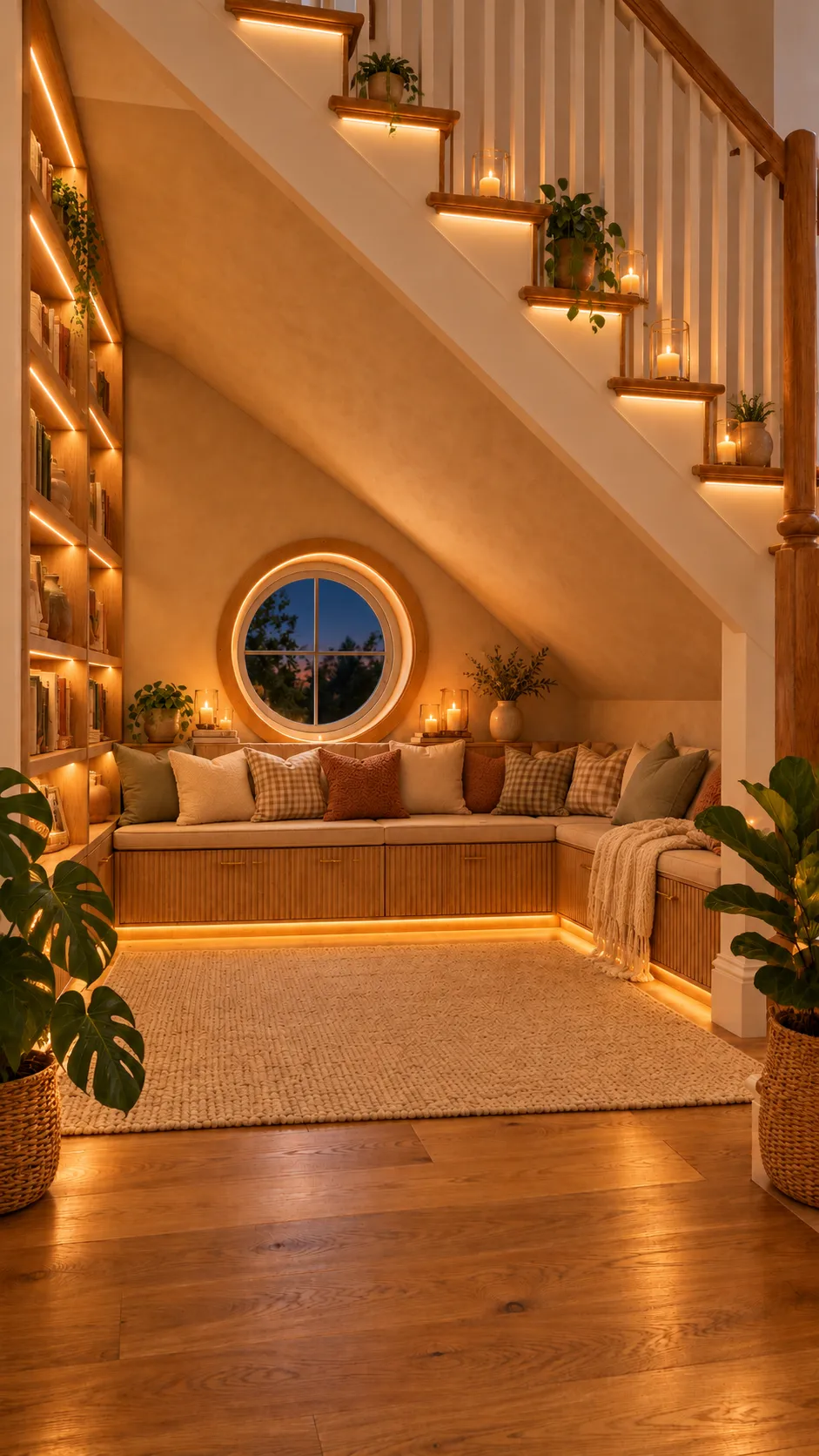
Under-stair corner with a circular window
The trouble with nearly every under-stair void is that it has no light: it sits in the middle of the house with a blind wall at the back, which is why it ends up as a store. Here the back plane faces outside and a round window has been opened, so the corner becomes the one place in the house where you can read by day without switching anything on. The L-bench and the shelving come afterwards; what changes the void is the hole in the wall.
Ventana circularBanco en LLuz naturalBajo escaleraEstantería de paredVelas en peldañosOjo de bueyRincón de lecturaCojines de linoMacetas
Design keys
A circular oeil-de-boeuf window in the back plane, centred on the bench rather than on the wall.
A built L-bench running two sides of the void, with the angle resolved by one square cushion.
Wall shelving above the bench, in the stretch where the stair leaves enough height.
Linen cushions in raw and earth tones, not competing with the light coming through the window.
Candles and small pots set on the stair treads themselves, always on the inner side.
Off-white walls up to the ceiling, which is what spreads the little light that comes in.
Furniture and decor in this design
5
Items shown are similar to those in the video, not necessarily identical.
Fixed circular aluminium window
A fixed round window with double glazing, the kind used to bring light to a blind plane without having to open it. Ask for the structural opening size, not the glass size: there is a good fifteen centimetres of frame and lining between them. If it will sit within arm's reach of a bench, choose laminated rather than toughened glass, because if it breaks it does not fall in pieces.
A large square cushion, fifty or sixty centimetres, which is what resolves the vertex of an L-bench where your back falls away. Buy it the same height as the straight back cushions so the top line runs on. In washed linen the fabric creases, which helps: in a reading corner a taut cushion looks unused.
Timber shelves with concealed brackets to fit above an under-stair bench. What decides whether they hold books is not the timber but the fixing: in a hollow partition use metal expansion anchors rather than the plastic plugs in the box, and a one-metre shelf with books wants three brackets, not two. Leave at least fifty centimetres clear above the seat so you do not hit your head.
A candle holder with a wide flat base, the only sort you can leave on a tread without it toppling. Tall-stemmed narrow-based ones are exactly what not to put on a stair. With children or animals about, flickering LED candles give the look without a flame and can be left lit as you go down.
A recessed or surface marker light picking out the next tread, which is what makes a stair with objects on it safe. Sensor battery ones stick on without any work and let you test the position before deciding whether running a cable is worth it. Choose warm light aimed downwards: a marker pointing at your eye dazzles and does exactly the opposite of its job.
Centre the window on the bench, not on the wall plane. If the bench takes two thirds of the wall, a window centred on the wall sits off-kilter relative to where people sit, and it is from the seat that it will always be looked at.
A round window needs more structural opening than it looks. Frame and lining add to the glazed size, so for sixty-centimetre glass reckon on an opening of about seventy-five, and check first that no beam or ring beam passes there.
Resolve the L-bench's angle with one square cushion rather than two rectangular ones meeting. In the corner, two straight cushions leave an empty wedge where your back drops away; one square cushion filling the whole angle gives the support missing exactly there.
If you put things on the treads, always put them on the inner side and never in the walking line. A stair's clear width should not drop below eighty centimetres, and a pot on the outer edge is what trips you at night, going down without putting the light on.
Paint the whole void in the palest tone you can accept. With a single small window, what lights the corner is not the glass but the wall returning that light: the same void in a mid tone calls for artificial light four hours earlier.
FAQ
Can you open a window in an under-stair void?
You can if that plane faces outside and is not loadbearing, and it is the intervention that changes an under-stair void most, far more than any piece of furniture. Three things want checking first. First, whether the wall is structural: in an internal partition or a non-loadbearing masonry skin the opening needs no more than a lintel, whereas in a loadbearing wall it needs calculation and a steel section, and that is already major work. Second, what runs inside the wall, because the underside of a stair is where soil pipes and services tend to climb. Third, consent: opening a new hole in a facade affects the building's exterior, and in a block of flats or a protected area it has to be applied for. If any of the three fails, the alternative is an internal window to the hall or a rooflight into the stairwell.
Can you put plants and candles on the stair treads?
Yes, with two rules that are not negotiable. First, the side: everything goes tight against the wall, on the tread's inner side, and never on the outer edge or in the middle of the going. A stair's clear width should not drop below eighty centimetres, so measure what is left once the object is in place and, if it falls below that, it does not fit. Second, stability: pots with a wide heavy base, never tall narrow terracotta, and candles in flat-bottomed holders or straight-sided pillars. And one detail decides whether the idea works: how you come down at night. If that stair has no marker lighting or a switch top and bottom, anything on the treads ends up as a trip, and what works is placing them only on the first two or three, which are the ones seen from below.
How do you resolve the corner of an L-shaped bench?
With one square cushion filling the whole angle, not two rectangular ones meeting. In an L-bench, the corner is the most used part, because it is where people lean sideways with their legs stretched along the other arm, and if two straight back cushions meet there you get an empty wedge through which your back falls into the corner. A square cushion the same height as the rest, set diagonally in the vertex, resolves that gap and also disguises the fact that the bench's two arms are not the same length. For the seats, the cleanest answer is a single continuous cushion per arm, with the cut right at the vertex; two cushions per arm multiply the joints and drift apart every time somebody gets up.
Some links on this page are affiliate links. If you make a purchase through them, we may earn a commission at no extra cost to you.
 Staircase
 Staircase
 Staircase
 Tu Casa