✨Interior images are AI-generated. Items shown are similar to those in the video.
Acogedor Familiar
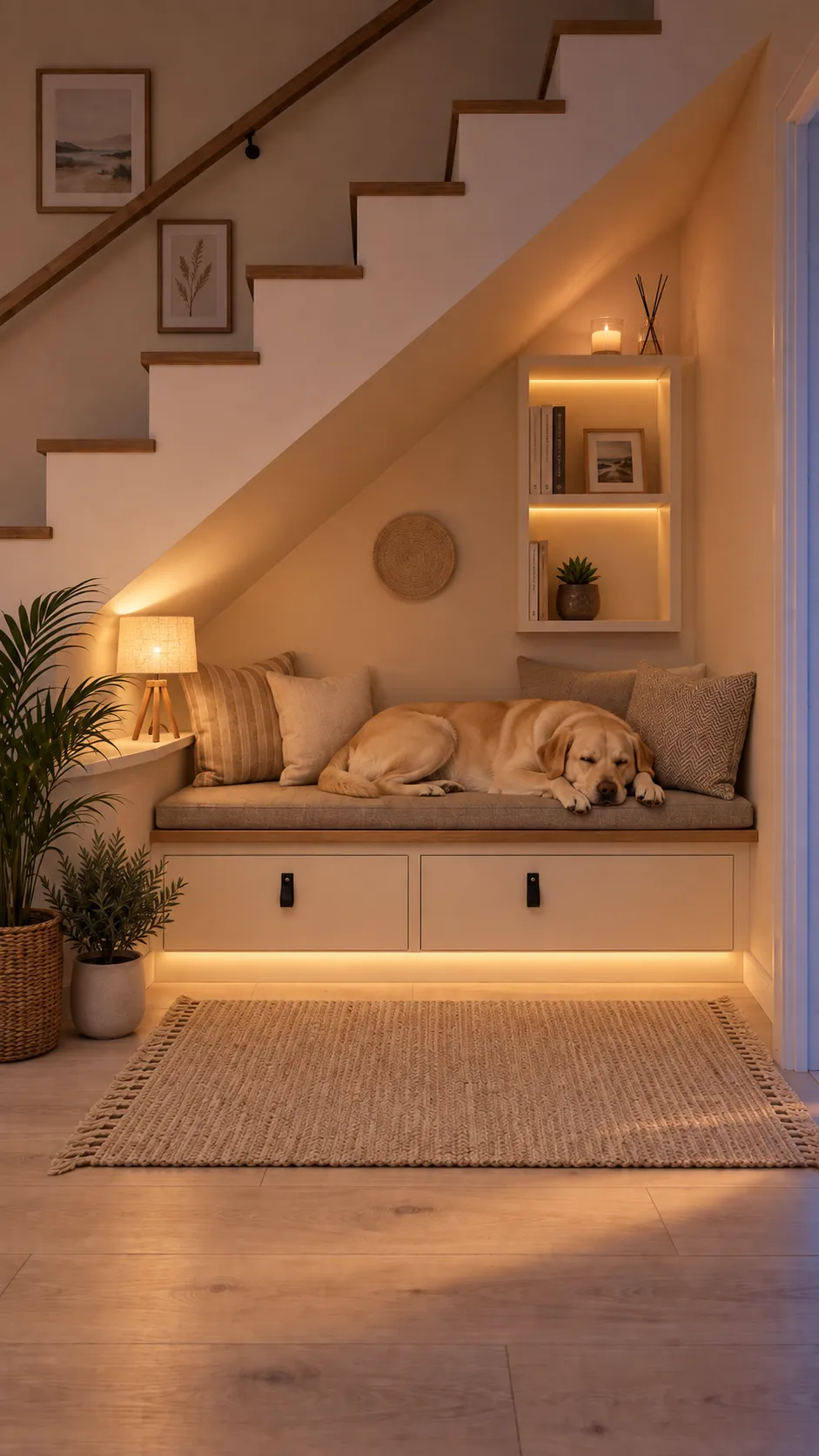
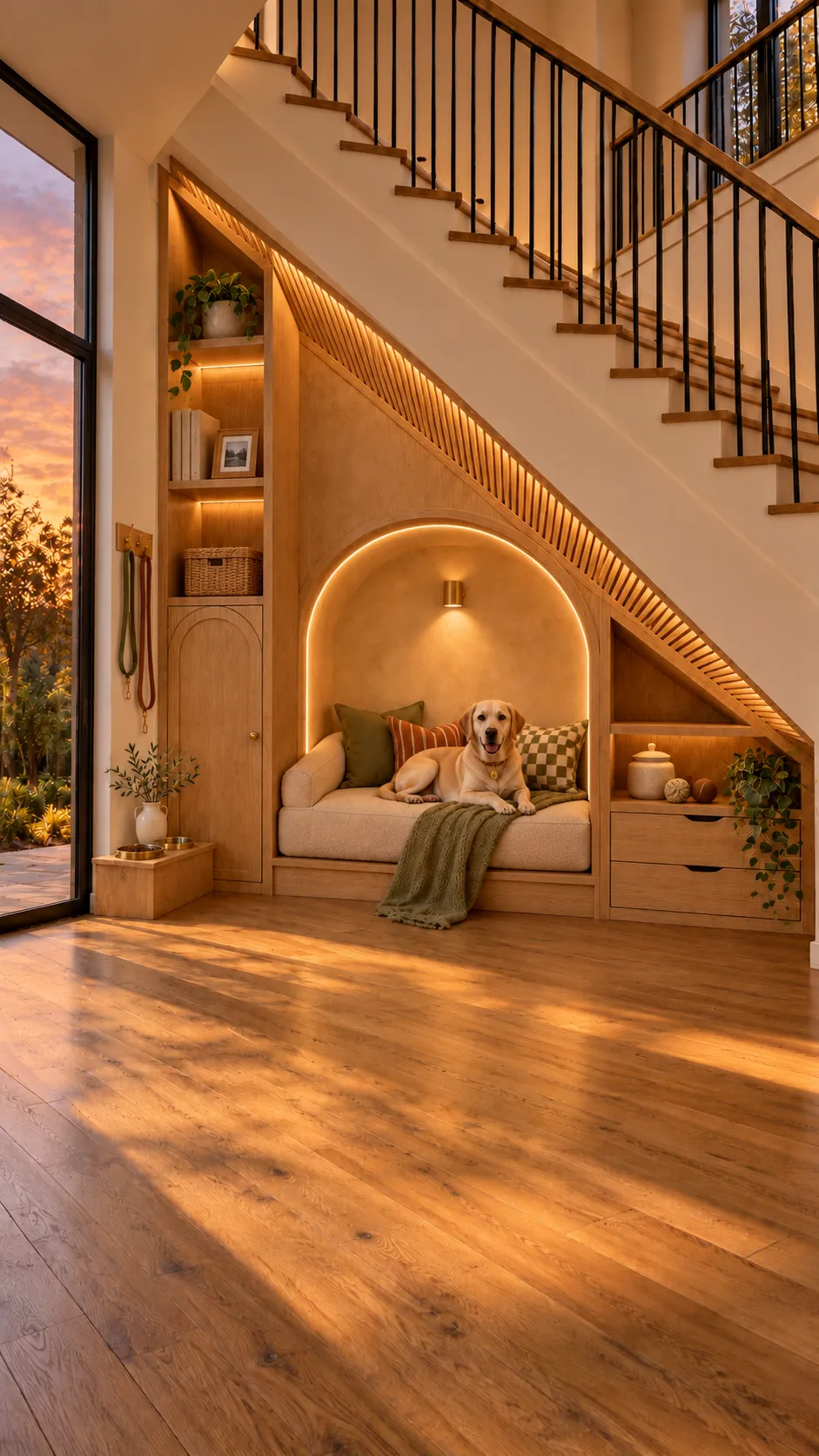
Under-stair nook turned into the dog's place
An under-stair void is one of the best spots in the house for a dog and hardly anyone approaches it that way. It has a low ceiling, it's closed on three sides and it sits out of the route, which is exactly what an animal looks for when choosing where to lie down. What changes against a normal bench is the materials: a seat used daily with fur and claws isn't the fabric you'd choose for a reading corner.
Rincón del perroBajo escaleraBanco con cajonesTejidos lavablesMascotas en casaAlfombra de yuteBaldas iluminadasLuz en el zócaloRecibidorAlmacenaje
Design keys
A low run of bench the dog steps up onto without having to jump.
Two drawers under the seat with leather pulls, holding everything of the animal's without adding furniture to the hall.
A light strip in the plinth, at floor level and out of the eyeline of whoever is lying on top.
A two-shelf lit niche up high, with whatever is better kept out of reach.
A close-weave jute rug in front of the bench, with no loops for a claw to catch.
A small table lamp at the end of the seat, the only warm light at that height.
Furniture and decor in this design
5
Items shown are similar to those in the video, not necessarily identical.
Waterproof washable seat cover
A cover with an inner membrane stopping liquids without the fabric looking plasticised, intended for a bench an animal uses daily. What to check is whether the membrane is in the cover or the filling: the one that genuinely protects is in the cover, because that's what goes in the machine. Choose a tone close to the animal's coat, the trick that saves reaching for the lint roller every time someone rings the bell.
A high-density foam mat, which is what an older dog needs when sleeping on a hard surface. The difference from an ordinary cushion tells in the joints: memory foam spreads the weight rather than leaving elbows pressed against the board. Measure him lying fully stretched rather than curled, because the dimension that matters is from the warm nights when he stretches out full length.
A roller with an adhesive surface or brush that cleans itself in its base, with no paper refills. For a seat a dog uses it's the tool actually picked up daily, because it's to hand and doesn't run out. Brush versions work better on close-weave fabrics and adhesive ones on smooth surfaces, so with cushions of different types it's worth having both.
An enzymatic spray that breaks down the source of the odour rather than covering it with perfume, which is the difference between solving it and postponing it. On a cushion in daily use, apply it to damp fabric and let it air dry rather than rubbing. Check it's marked as pet-safe: some air fresheners contain essential oils that irritate dogs and are distinctly dangerous for cats.
Screwed leather straps acting as handles, soft and without a hard edge, which on a low unit an animal brushes daily avoids knocks and scratched legs. They fit with two through-bolts and the leather can be replaced when worn without touching the front. Check the thickness: under three millimetres the strap folds and a loaded drawer becomes hard to open.
Keep the seat low, under forty centimetres. A young dog climbs any height, but with the years joints stop forgiving and a tall bench ends up unused; if he's already older, a ramp or a step in front solves the same thing.
The cushion has to have a removable, machine-washable cover rather than fixed upholstery. A made-to-measure upholstered seat is impossible to clean thoroughly and within months holds odour; with a removable cover it's washed every few weeks and the filling survives.
Avoid loop-pile rugs and long pile. Loops catch on claws and unravel in strips, and long pile holds the animal's fur in a way the vacuum won't lift: a close weave in short fibre is what actually cleans.
Put the light strip low and facing the floor. At the height of a lying dog, an LED halfway up the wall sits right in front of his eyes; in the plinth it lights the route without bothering him and serves as a guide at night.
Keep the drawers for his things and the high shelves for everything else. Food, lead and towels below, where they're reached without bending twice; and above, out of reach, whatever is better not found.
FAQ
Is putting the dog's bed under the stairs a good idea?
It's one of the best spots in the house, for reasons to do with the animal rather than with decorating. A dog looks for somewhere with a low ceiling, closed on several sides and with a single entrance, because that lets him control the access without being exposed; an under-stair void has all three. It's also out of the route, so his place doesn't get stepped around, and it's usually near the door, which is where many dogs want to be. The only thing worth checking first is whether a hot water pipe runs under that staircase or the consumer unit sits there: in the first case the corner gets warmer than it should in winter, and in the second you need access without moving the animal.
What fabric survives on a seat a dog uses?
A close-weave one with a removable cover, which are two separate conditions and both matter. Close weave, like a canvas or a technical outdoor fabric, doesn't let a claw catch or fur work in between the fibres, unlike bouclé or chunky knit, which look hard-wearing and come apart in threads. The removable cover is what allows genuine washing: fixed upholstery only cleans on the surface and the odour stays in the foam. If you also want liquid resistance, there are fabrics with a water-repellent treatment that repel without being plasticised. What to avoid is velvet, which marks with every pass and shows the animal's route as he settles.
What rug suits a house with a dog?
A short-fibre, close-weave one, and preferably cut pile rather than loop. Loop is a claw's worst enemy: it catches, pulls the thread and the rug starts unravelling in a line. As for fibre, jute and sisal take traffic well and disguise dirt, though they absorb liquids and are better avoided with a puppy or an older dog. Polypropylene is the most practical with a pet, because it washes with water without spoiling and doesn't hold odour. And one measure that helps more than the material: keep the rug small and manageable, because the one you can shake out and wash whole is the one that actually stays clean.
Some links on this page are affiliate links. If you make a purchase through them, we may earn a commission at no extra cost to you.
 Staircase
 Staircase
 Staircase
 Tu Casa